
Standard MAT program requirements were never designed to judge your history or lock you out of recovery; they exist simply to protect your health and personalize your medical care. If you've felt anxious about testing positive during an intake drug screen, worried that past relapses disqualify you, or feared being turned away at the clinic door, you aren't alone. Clinical guidelines can easily feel like cold bureaucratic hurdles when you're already carrying the vulnerability of seeking help.
In reality, initial diagnostic screenings give medical providers an honest clinical baseline to keep you safe, not an excuse for rejection. In this guide, you'll discover the exact eligibility criteria for outpatient buprenorphine and naltrexone care, clarify what documentation to bring, and learn how flexible insurance and telehealth pathways function today. Here is your clear, compassionate checklist for entering treatment with total confidence in 2026.
Key Takeaways
- Understand standard MAT program requirements, which center on a clinical diagnosis of opioid use disorder and your voluntary consent rather than an expectation of past perfection.
- Learn the essential documents to bring to intake, including a valid photo ID and active insurance or Medicaid details, to streamline your evaluation.
- Discover the specific clinical timing needed for medications like Suboxone, Sublocade, and Vivitrol, ensuring you know how induction works for each option.
- See how ongoing outpatient compliance integrates routine medical check-ins, supportive screenings, and behavioral health counseling to sustain your overall wellness.
- Find out how virtual consultations verify eligibility securely from home, allowing you to access compassionate care without unnecessary travel barriers.
Understanding MAT Program Requirements: Core Clinical Criteria for Admission
Searching for addiction support should never leave you sifting through confusion about academic teaching degrees. In clinical medicine, MAT program requirements evaluate whether outpatient care can safely and effectively support your recovery journey. Unlike older statutory regulations that demanded rigid one-year histories of documented physical dependence, modern outpatient protocols prioritize compassionate clinical judgment and immediate health stabilization.
DSM-5 Diagnostic Standards for Opioid Use Disorder
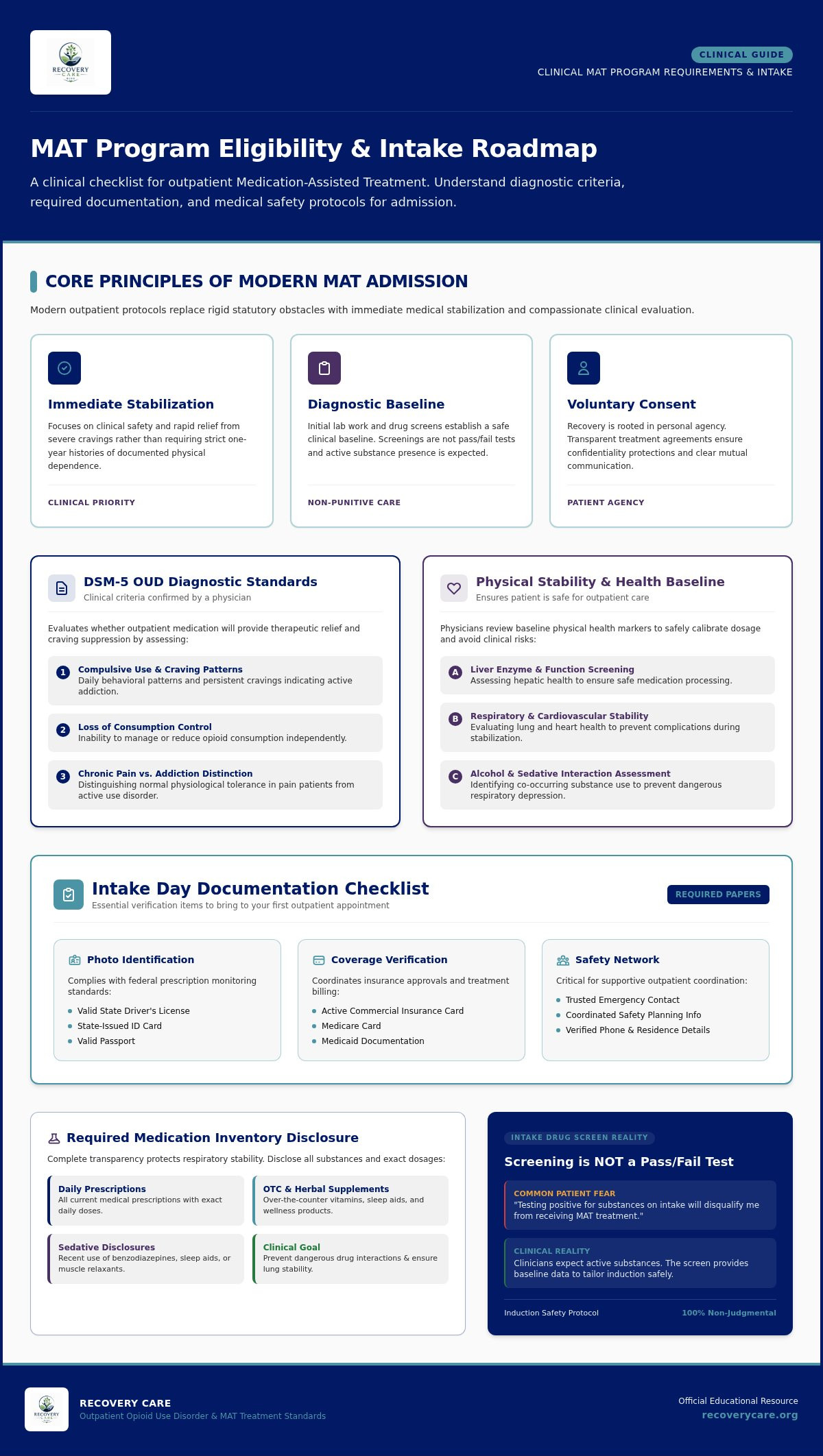
Admission begins with confirming an Opioid Use Disorder (OUD) diagnosis using standardized medical criteria. A physician reviews daily behavioral patterns, including compulsive use, persistent cravings, and loss of control over consumption. Medical teams carefully distinguish between expected physiological tolerance in chronic pain patients and active addiction. When applying Opioid replacement therapy, this clinical evaluation verifies that medications like sublingual buprenorphine will provide meaningful therapeutic relief and craven suppression.
Medical Stability and Health History Screenings
Safe medical care requires an honest evaluation of your baseline physical health. Providers review your medical history, paying close attention to liver enzymes, respiratory conditions, and cardiovascular stability. Initial diagnostic screenings and lab work are essential, but they serve as clinical benchmarks rather than grounds for denial. Identifying concurrent alcohol or sedative use helps your doctor prevent dangerous drug interactions and tailor your dosing safely. Outpatient care works best when you are medically stable enough to recover safely from home.
Voluntary Participation and Informed Consent
Sustainable recovery depends on your personal agency and self-determination. Core MAT program requirements involve providing valid government identification for federal prescription monitoring, but the process centers on your voluntary consent. Your care team takes time to outline confidentiality protections, treatment expectations, and potential side effects so you can make informed decisions. Signing a treatment agreement marks the start of a supportive partnership built on dignity, mutual trust, and clear communication.
Intake Day Checklist: What You Need for Your First Appointment
Preparing for your first medical appointment can bring up natural apprehension, especially if you aren't sure what paperwork is necessary. Modern MAT program requirements focus on establishing a clear clinical picture, giving your medical team the accurate history they need to treat you safely. Having your documents organized ahead of time helps intake run smoothly so you can focus entirely on your health.
Essential Documentation and Verification Papers
Your appointment begins with verifying your identity and treatment coverage. Bring a government-issued photo ID, such as a state driver's license, identification card, or passport. You will also need your active commercial health insurance card, Medicare card, or Medicaid documentation. Under current federal MAT program regulations, these documents confirm patient identity, coordinate insurance approvals, and ensure strict compliance with prescription monitoring standards.
- Photo Identification: Valid state ID, driver's license, or passport.
- Insurance Coverage: Current commercial, Medicare, or Medicaid cards.
- Support Network: A trusted emergency contact for coordinated safety planning.
Medication Inventories and Prescription History
Transparency regarding your current medications protects your physical safety. Write down all daily prescriptions, over-the-counter supplements, and herbal products you take, including exact dosages. Be completely candid about recent use of benzodiazepines, sleep aids, or muscle relaxants. Outpatient clinicians don't judge your history; they assess sedative exposure to prevent dangerous interactions and protect your respiratory stability.
What to Expect During the Intake Clinical Evaluation
Many patients worry that testing positive on an intake drug screen will disqualify them from receiving help. In reality, clinicians expect active substances in your system. This initial screening is never a pass/fail exam; it simply provides vital clinical baseline data that informs your care plan. If you are starting Suboxone treatment, this diagnostic screening helps your provider time your first dose properly to prevent precipitated withdrawal. When you are ready to begin, you can schedule a confidential consultation with a supportive provider who will walk you through each intake requirement step by step.
Requirements by Medication Type: Suboxone, Sublocade, and Vivitrol
Every recovery journey involves distinct clinical considerations, and medication criteria vary significantly depending on the compound your physician prescribes. Understanding these specific MAT program requirements ensures you arrive at treatment prepared for the exact physiological induction steps required for your prescribed therapy.
Sublingual Buprenorphine and Suboxone Induction Standards
Starting sublingual buprenorphine requires entering mild-to-moderate withdrawal before taking your first dose. Clinicians use the Clinical Opiate Withdrawal Scale (COWS) to measure signs like pupil dilation, restlessness, and muscle aches. Taking buprenorphine while full opioid agonists remain active on brain receptors can trigger severe precipitated withdrawal. For safety, patients must demonstrate they can securely store daily film or tablet doses at home and self-administer them as directed.
Eligibility Criteria for Monthly Sublocade Injections
Sublocade provides a continuous, month-long release of buprenorphine, eliminating the daily dosing routine of oral medications. Patients cannot begin with an injection immediately. You must first complete clinical dose stabilization on sublingual buprenorphine for at least seven days. This induction window confirms your physical tolerance to the medication without adverse effects. Review our comprehensive Sublocade injection guide to see if your stabilization history and schedule match the criteria for monthly in-clinic subcutaneous administration.
Detoxification Prerequisites for Vivitrol Treatment
Vivitrol takes a completely different clinical approach because naltrexone functions as an opioid antagonist. While buprenorphine eases withdrawal during induction, Vivitrol blocks opioid receptors entirely and demands complete detoxification before your first injection.
- Short-Acting Opioids: Strict abstinence for 7 to 10 days prior to administration.
- Buprenorphine or Methadone: Extended clearance window of at least 14 days before starting.
- Challenge Screenings: A preliminary naloxone challenge may be administered to verify that all receptors are completely clear.
Meeting specific medication criteria protects your physical safety and prevents acute discomfort. Your clinical team will help you evaluate these physiological timelines to identify which outpatient treatment option aligns best with your current health status and lifestyle.
Ongoing MAT Compliance: Counseling, Screenings, and Appointments
Completing intake is a major milestone, but long-term recovery flourishes through steady, compassionate follow-up. Standard MAT program requirements after admission are structured around clinical safety, ongoing emotional reinforcement, and regular wellness evaluations rather than rigid oversight.
Behavioral Health and Counseling Participation
Healing involves more than stabilizing receptor sites in the brain; it requires understanding personal stress patterns. Engaging in regular therapy helps you process emotional triggers, rebuild personal relationships, and navigate everyday pressures. Learn how counseling for opioid addiction complements medication therapy to treat concurrent anxiety or depression. Many programs offer virtual counseling options, providing flexible access that accommodates work, family, and personal schedules without compromising privacy.
Periodic Diagnostic Testing and Toxicology Guidelines
Fear of periodic drug screening causes significant anxiety for patients, but these check-ins serve as clinical health tools, not moral tests. Outpatient clinicians use routine urine or oral fluid screenings to monitor therapeutic buprenorphine metabolite levels, confirming your body absorbs the medication properly. If unexpected substances appear, an ethical care team doesn't cast you out. Instead, clinicians treat a positive test as valuable diagnostic data, using it to adjust medication doses, intensify counseling support, or explore new safety strategies together.
- Dosage Adjustments: Medical evaluations ensure your current prescription manages cravings effectively.
- Safety Conversations: Transparent dialogue replaces punitive policies when stressors or slips occur.
- Adherence Verification: Lab work confirms active medication levels to protect your physical stability.
Primary Healthcare Integration for Holistic Stability
Substance use disorder rarely exists in isolation from general health. Outpatient recovery thrives when paired with routine primary medicine to address cardiovascular fitness, sleep hygiene, and preventive exams. Explore our complete guide to primary care for recovery patients to see how managing chronic physical conditions reinforces emotional resilience. Ongoing compliance simply means staying connected with your providers so your treatment adapts as your life improves. If you're ready to partner with a medical team dedicated to whole-person healing, connect with an outpatient provider today to explore your options.
Telehealth MAT Requirements: How Virtual Programs Verify Eligibility
Accessing addiction medicine from the privacy of home has removed transportation hurdles and scheduling friction for thousands of individuals. Even in a digital setting, telehealth MAT program requirements maintain strict clinical rigor to protect your health. Virtual care follows updated federal DEA rules and state medical board standards, requiring you to be physically located in the state where your provider is licensed during every virtual visit.
Technical and Privacy Standards for Remote Care
Virtual evaluations require a smartphone, tablet, or desktop computer with a functional camera, microphone, and stable internet connection. Because medical consultations cover sensitive personal topics, you must connect from a private, secure location free from distractions. Discover how telehealth addiction counseling pairs structured digital therapy with medical oversight to support your long-term independence.
Remote Drug Testing and Prescription Coordination
Maintaining accountability in virtual programs is straightforward and supportive. Providers coordinate routine toxicology using mail-order oral fluid swab tests observed over secure video, or through scheduled visits to a nearby certified laboratory. When your clinician issues an electronic prescription for buprenorphine, you'll designate an established local pharmacy that consistently stocks your medication. Depending on specific clinical considerations and state telehealth regulations, periodic in-person evaluations may occasionally be scheduled to ensure comprehensive medical safety.
Connecting with Compassionate Outpatient Care at Recovery Care
Meeting MAT program requirements doesn't have to feel intimidating or overwhelming. At Recovery Care, care is led by Dr. Heather Rosen, MD, offering patient-centered outpatient medical evaluations, buprenorphine management, long-acting injectables, and virtual visits. Our integrated care model combines primary medical support and counseling while accepting major commercial insurances, Medicare, and Medicaid. Taking the first step toward medical recovery is completely confidential, dignified, and designed to meet you exactly where you are today.
Begin Your Recovery Journey with Confidence
Understanding MAT program requirements reveals that treatment admission is rooted in clinical safety and patient dignity rather than judgment. Whether you begin with sublingual medication, transition to long-acting injectables, or connect from home, each clinical benchmark exists to protect your health and support your ongoing stability.
You don't have to navigate this process alone. Recovery Care provides physician-led care directed by Medical Director Dr. Heather Rosen, MD, delivering comprehensive outpatient options including Suboxone, Sublocade, and Vivitrol. With major commercial health insurance, Medicare, and Medicaid accepted across accessible in-person visits and confidential telehealth appointments, respectful medical support is within reach. Schedule your confidential, non-judgmental intake consultation with Recovery Care today and take the first decisive step toward the healthy, independent future you deserve.
Frequently Asked Questions
Can I be disqualified from an outpatient MAT program if I test positive for drugs at intake?
No, you won't be disqualified for testing positive during your intake visit. Outpatient clinicians expect active substances in your system when you reach out for help. Testing provides essential baseline data, helping providers select appropriate dosages and prevent dangerous drug interactions. Honest communication ensures your safety, and providers view initial screenings as a starting point for care rather than a reason to turn you away.
Do I have to go through painful opioid withdrawal before starting an MAT program?
You don't have to endure severe, agonizing withdrawal before beginning treatment. While medications containing buprenorphine like Suboxone require you to be in mild-to-moderate withdrawal to prevent precipitated symptoms, your clinical team guides you closely through this transition. If you choose Vivitrol, complete opioid clearance is medically necessary. Standard MAT program requirements always prioritize your physical comfort and clinical safety at every stage of the induction protocol.
What documents do I need to bring to my first MAT program appointment?
You should bring a valid government-issued photo ID, your active insurance card, and an accurate list of all current prescriptions. Acceptable identification includes a driver's license, state ID card, or passport. If you have commercial health insurance, Medicare, or Medicaid, bring your policy card or digital coverage details. Having medical records of past treatment attempts or chronic health conditions is also helpful for coordinating whole-person primary care and counseling.
Can I qualify for an MAT program using Medicaid or Medicare insurance coverage?
Yes, you can qualify using Medicaid or Medicare coverage. Modern outpatient clinics accept Medicaid, Medicare, and most commercial insurance plans to ensure life-saving addiction medicine remains accessible. Your coverage typically applies to clinical doctor visits, routine lab diagnostics, counseling sessions, and prescribed medications like Suboxone, Sublocade, or Vivitrol. Intake coordinators will verify your benefits prior to treatment so you know exactly what is covered without unexpected hurdles.
Is regular counseling mandatory to stay enrolled in a medication-assisted treatment program?
Behavioral health counseling is a recommended core component of comprehensive outpatient recovery, though programs approach it supportively rather than punitively. Therapy helps you explore emotional coping strategies, heal past trauma, and navigate co-occurring conditions like anxiety or depression. Integrating behavioral health counseling alongside medical management provides the highest chance of long-term success, and clinicians work with you to find flexible session formats that fit your personal schedule.
Can I complete all my MAT program requirements through telehealth appointments?
Many outpatient programs allow you to fulfill standard MAT program requirements completely through virtual consultations, depending on federal rules and individual state regulations. Telehealth appointments let you meet with your physician, complete clinical assessments, and attend therapy from home via secure video. Prescriptions are sent directly to your local pharmacy. Long-acting injectable therapies, such as Sublocade or Vivitrol, still require occasional in-person clinic visits for safe medical administration.
What happens if I miss a scheduled MAT medication management appointment?
If you miss an appointment, contact your clinic immediately so your care team can help you reschedule safely. Outpatient providers understand that life emergencies, transportation issues, and family demands happen. Missing a visit won't automatically result in program discharge, but prompt communication is critical to prevent gaps in your prescription refills. Your medical team will work with you to get your schedule back on track while keeping your stabilization steady and supported.


