

The cost of a Vivitrol shot without insurance varies because the medication, injection administration, and related treatment services may be billed separately. Insurance may cover Vivitrol through medical or prescription benefits, and eligible patients may qualify for medication assistance. Office visits and administration can still be separate expenses.
If affordability is a concern, it helps to separate the medication cost from the cost of receiving the injection and related care. What you pay depends on how treatment is billed, any insurance benefits, and eligibility for assistance. This article explains the main cost factors and coverage routes, so you can make a clearer plan.
Key Takeaways
- Budget for more than the medication: administration and related treatment services can also affect your out-of-pocket total.
- Find out whether your plan covers Vivitrol under medical benefits, prescription benefits, or both, and how deductibles or prior authorization apply.
- Explore the manufacturer’s savings program and patient assistance options to see whether you may qualify for help with medication costs.
- Separate medication savings from appointment and administration expenses, which may not be covered by the same program.
- Compare treatment options with a qualified care team so that cost considerations fit into a plan suited to your needs.
Out-of-pocket costs for eligible patients
Before receiving a Vivitrol shot, patients need a valid prescription and clinical assessment. They must stop taking opioids for at least 7 to 14 days before treatment to avoid sudden withdrawal, unless their doctor determines otherwise. Patients currently using opioids, experiencing withdrawal, or with a history of allergic reactions to naltrexone may not be suitable candidates.
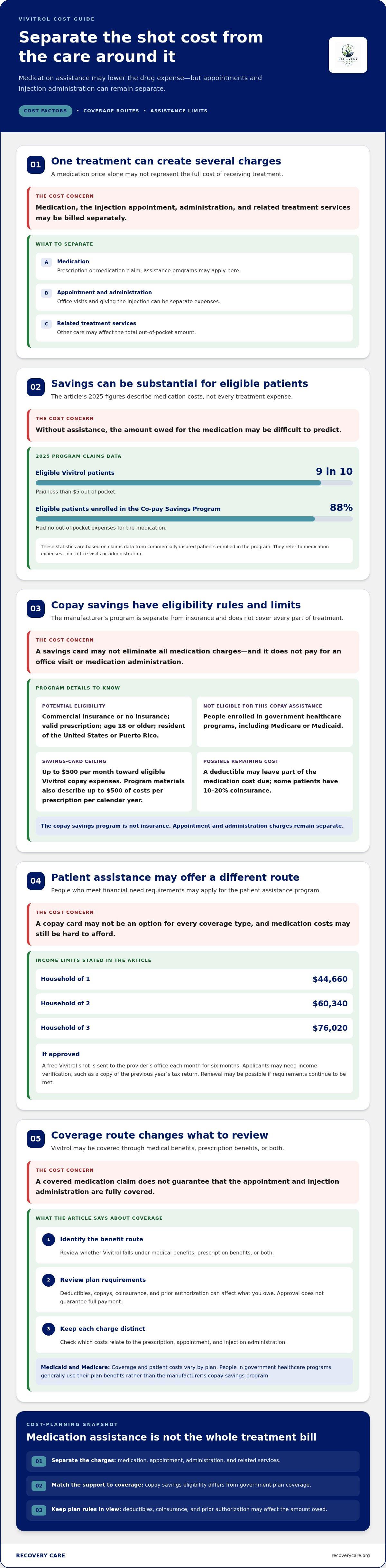
For eligible patients, manufacturer assistance can substantially reduce medication expenses. In 2025, 9 out of 10 eligible Vivitrol patients paid less than $5 out of pocket. Also in 2025, 88% of eligible patients enrolled in the Vivitrol Co-pay Savings Program had no out-of-pocket expenses for the medication. These statistics are based on claims data from commercially insured patients enrolled in the program.
The Co-pay Savings Program is available to eligible patients with commercial insurance or no insurance. Patients need a valid Vivitrol prescription, must be at least 18 years old, and must live in the United States or Puerto Rico. The program is not insurance. Patients enrolled in government healthcare programs, including Medicare or Medicaid, aren’t eligible for this manufacturer copay assistance. Their coverage and costs are handled through their government plan.
The savings card covers up to $500 per month toward eligible patients’ Vivitrol copay expenses. Program materials also describe coverage of up to $500 of a patient’s costs per prescription per calendar year. A patient with a deductible may still owe part of the medication cost until meeting that deductible. Some patients also have coinsurance of 10-20% of the cost. The copay card may help with medication expenses, but it doesn’t pay for office visits or medication administration.
People who meet financial-need requirements may also apply for patient assistance. Stated household income limits are $44,660 for one person, $60,340 for two, and $76,020 for three. Approved applicants receive a free Vivitrol shot sent to their provider’s office each month for six months. Applicants may need to provide income verification, such as a copy of the previous year’s tax return. Renewal may be possible if applicants continue meeting requirements.
To explore assistance, first identify whether you have commercial insurance, government coverage, or no insurance, then review the eligibility rules for the relevant programs. If you’re considering treatment for opioid or alcohol dependence, discuss counseling and other support alongside medication. Assistance may reduce the medication expense, while other treatment costs can remain separate.
Insurance coverage for Vivitrol
In the United States, insurance may cover Vivitrol through medical or prescription benefits. Your plan’s rules determine how treatment is billed and what you pay.
Insurance and Out-of-Pocket Expenses
Insurance coverage means a health plan pays some eligible treatment expenses under its benefits. Your remaining out-of-pocket amount can depend on deductibles, copays, coinsurance, and prior authorization requirements.
Vivitrol may fall under medical or prescription benefits, so the billing route matters. A medication claim and an injection appointment may involve different charges. The manufacturer’s savings program applies to medication costs, not office visits or medication administration.
For example, a plan may cover the medication but bill administration separately. Prior authorization may be required, and approval doesn’t guarantee insurance will pay the full treatment cost. Review your benefits to see which expenses apply to the prescription, appointment, and injection.
Eligible patients may receive program benefits for valid Vivitrol claims dated up to 90 days before their initial enrollment date. That retroactive window can matter if you paid for a prescription before enrolling. Alkermes’ Vivitrol Co-pay Savings Program is separate from insurance, so it doesn’t replace the plan or cover every treatment expense.
Medicaid and Medicare Coverage
Medicaid and Medicare coverage for Vivitrol, including patient costs, can vary by plan. People enrolled in government healthcare programs generally use their plan benefits rather than the manufacturer’s copay savings program.
Medicaid plans in all 50 states and the District of Columbia cover Vivitrol, although requirements may apply. As of September 2024, 99% of people with any insurance, including Medicaid, were covered for Vivitrol. Coverage can still involve plan conditions, such as prior authorization or cost-sharing.
Among Medicaid patients, 99% pay $4 or less for Vivitrol. That figure describes medication costs, not necessarily every appointment or administration expense. Medicare also covers Vivitrol, but the applicable benefits determine how claims are processed and what a patient owes.
If you’re comparing coverage, identify whether the claim concerns the medication or its administration. Then review the applicable medical or prescription benefit, along with any plan requirements. For treatment information, explore Vivitrol injection care as part of a conversation about your options.
Can I get financial help for Vivitrol treatment?
Cash costs depend on the medication, where it’s obtained, and how treatment is delivered. Comparing the injection with generic oral naltrexone can help clarify the financial trade-offs.
Cash Price for an Injection
The cash price is what you pay directly when insurance doesn’t cover an injection. Medication and treatment services may create separate expenses.
Vivitrol is administered as an intramuscular injection once every 28-30 days. Its cash price can vary by pharmacy and treatment setting. The medication charge may not include the appointment or administration, so those costs should be considered separately when planning expenses.
Published cash prices can differ because pharmacies and care settings use different pricing arrangements. A listed medication price may not represent the full cost of treatment. For example, an injection arranged through an opioid treatment program can involve charges beyond the medication itself.
Uninsured Cost in the United States
The cost of a Vivitrol shot without insurance is the patient’s cash expense for medication and related care. Separating those components helps you understand what the medication price does, and doesn’t, include.
There isn’t one cash amount that applies to every patient. Pharmacy pricing, treatment location, administration, and other services can change the total. Federally Qualified Health Centers may provide Vivitrol on a sliding-scale fee basis, which can make the overall expense more manageable for eligible patients.
Generic oral naltrexone offers a different medication format and cost structure. A common oral dose is a 50mg tablet once daily; Vivitrol is an injection rather than a daily tablet.
There’s no generic Vivitrol approved for opioid use disorder. Generic oral naltrexone is available, but it isn’t the same as the injection. The options differ in how they’re taken, so compare medication expenses along with the treatment approach and support that fit your needs.
Financial assistance may help eligible patients manage medication expenses. The manufacturer’s savings and patient assistance programs have separate eligibility rules, and the copay program doesn’t pay for office visits or administration. Federally Qualified Health Centers may offer sliding-scale fees. Consider medication, injection services, and other treatment costs separately.
Cost comparisons shouldn’t be the only factor in treatment decisions. Vivitrol must be started after stopping opioids for at least 7 to 14 days, unless a doctor determines otherwise, to avoid sudden withdrawal. Discuss how medication, counseling, and support for behavior change fit together when weighing treatment options.
Factors affecting Vivitrol costs
Your total depends on more than the medication. Insurance terms, treatment location, administration, and related services can all affect what you pay.
Coverage and Out-of-Pocket Costs
Insurance coverage determines which Vivitrol treatment expenses a plan pays and which remain your responsibility. Coverage can change your out-of-pocket amount without covering every part of care.
Plan terms, state of residence, clinical diagnosis, and treatment setting can affect coverage. Prior authorization, deductibles, copays, and coinsurance may also apply. Prior authorization doesn’t guarantee that the insurer will cover the full treatment cost.
Check whether Vivitrol falls under your medical or prescription benefits. Then separate medication coverage from appointment and administration expenses. This makes it easier to understand how your plan applies to each part of treatment.
Geographic Cost Variation
Treatment expenses can differ by location and care setting because the same medication may be provided through different healthcare arrangements.
Vivitrol costs can vary with the treatment location and healthcare provider. State of residence may affect insurance coverage, while the setting can influence which services are included. A pharmacy purchase and an injection arranged through a treatment program may have different billing components.
Compare what each treatment estimate includes, rather than focusing only on the medication. Check whether administration, counseling, or other related services are part of the care plan.
Treatment Cost Components
Vivitrol treatment costs can include the medication, its administration, and related services. Knowing what each component covers matters because medication assistance may not cover the full recovery plan.
For example, the VIVITROL Co-pay Savings Program applies to medication out-of-pocket costs, not office visits or medication administration. Counseling or therapy may also be part of addiction treatment and affect the overall expense.
Frequency is another factor: Vivitrol is administered once a month as an intramuscular injection. The treatment location, provider, and additional services can shape the overall arrangement. Separate each component when reviewing coverage or assistance options.
Vivitrol can trigger sudden opioid withdrawal if treatment begins before the required opioid-free period. Patients must stop taking opioids for at least 7 to 14 days beforehand, unless their doctor determines otherwise. Opioid overdose or accidental opioid use requires emergency help: call 911, even if naloxone or nalmefene has been given.
Your Vivitrol treatment price depends on the medication, administration, location, insurance, and related services. An individual quote reflects the details of your case.
When assessing your options, consider whether you may qualify for insurance coverage or assistance programs. Also discuss whether Vivitrol is clinically appropriate for opioid or alcohol recovery, rather than weighing cost alone. Talk with the healthcare professional overseeing your treatment about medication risks and potential side effects.
Vivitrol shot cost
The cost of a Vivitrol shot without insurance isn’t the same as the full cost of treatment. A useful estimate separates the medication from injection administration and related care, then accounts for how often treatment is planned.
Vivitrol is a brand-name naltrexone injection. There’s no generic version approved for opioid use disorder, so generic oral naltrexone isn’t a direct price comparison for the same medication form. A healthcare provider can explain how the injection may fit a treatment plan for opioid or alcohol dependence.
Consider two parts: the charge for each medication dose and any separate care expenses. For example, an injection arranged through an opioid treatment program may include services beyond the medication. The pharmacy, provider, and treatment setting can affect how charges are structured.
To understand recurring expenses, estimate the medication cost across the planned treatment period, then account separately for administration and related services. Vivitrol injections are given once every 28-30 days. That schedule makes the per-dose amount only one part of a longer-term budget.
Insurance can change what a patient pays, but the billing route matters. Vivitrol may be billed under medical or prescription benefits. Deductibles, copays, coinsurance, and prior authorization can affect your responsibility, while administration may be billed separately from the medication.
Manufacturer assistance may help eligible patients with medication expenses, but it doesn’t cover every part of care. The VIVITROL Co-pay Savings Program doesn’t pay for office visits or medication administration. Separate medication savings from the broader costs of addiction treatment, including counseling and other support.
For a useful comparison, use the same categories for each estimate: medication, administration, and related treatment services. One setting may quote the medication alone, while another may describe a wider treatment package. Comparing unlike totals can make the cash cost seem higher or lower than it is.
Before deciding, ask how the medication and administration are billed, whether the estimate covers the full treatment period, and how insurance or assistance applies to eligible expenses. Discuss whether Vivitrol is clinically appropriate, too. Starting it requires an opioid-free period, and treatment planning should account for dependence and recovery needs.
Recovery Care: Suboxone Treatment
Recovery Care offers Suboxone Treatment for people seeking outpatient care for opioid addiction. If you’re comparing Vivitrol’s costs with other medication options, a treatment discussion can help you consider affordability alongside clinical fit. Recovery Care also provides Vivitrol Injections, Sublocade Injections, and Telehealth Consultations.
Medication choices depend on your health needs and treatment goals, not price alone. A care discussion can help you understand which option may suit your recovery plan and what to ask about insurance or financial assistance. You deserve clear information and respectful support as you consider your next step.
Contact Recovery Care to discuss treatment options.
Choose a Next Step That Fits Your Recovery
Cost matters, but it’s only one part of deciding how to move forward. The cost of a Vivitrol shot without insurance can raise questions about treatment fit, ongoing support, and which options may be manageable for your circumstances. You deserve a conversation that considers your goals and health needs, not just a medication choice.
Recovery Care offers Suboxone Treatment, Sublocade Injections, and Vivitrol Injections. A conversation with the care team can help you weigh these options and identify what you want to understand before deciding. Bring questions about your treatment goals, coverage, and support needs.
Taking the next step doesn’t require having every answer in advance. Start with the question that matters most to you, and let the conversation develop from there. Contact Recovery Care for support as you explore your options.
Your path forward can begin with one thoughtful conversation, at your pace.
Frequently Asked Questions
What is Vivitrol?
Vivitrol is a brand-name, extended-release naltrexone injection used to help prevent relapse in people recovering from opioid or alcohol dependence. It’s given into a muscle once a month and works differently from daily oral naltrexone. Vivitrol is part of treatment, not a standalone recovery plan; counseling and other support can also be important. Before starting, patients need an opioid-free period to reduce the risk of sudden withdrawal.
What is the cash price of Vivitrol 380 mg at pharmacies?
The pharmacy cash amount for a 380 mg dose varies by pharmacy, and a medication-only price may not include administration or other care. That distinction matters: an amount for the drug isn’t automatically the full treatment expense. Ask what the quoted amount includes, such as the medication, injection service, or appointment. For budgeting, keep each component separate rather than treating one pharmacy figure as the complete cost.
What fees for evaluation, lab tests, and treatment are added to Vivitrol's cost?
Additional charges may include a clinical evaluation, medication management, treatment visits, or diagnostic and laboratory testing. The services involved depend on the care plan and setting, so there isn’t one universal list of tests or added charges. For example, a treatment program may bill an evaluation separately from the medication. Review an itemized estimate and distinguish clinical services from the Vivitrol dose itself.
Does the Vivitrol manufacturer offer patient assistance or savings programs for uninsured patients?
Yes. Eligible patients without insurance may qualify for the manufacturer’s Vivitrol Co-pay Savings Program, which is not insurance and has eligibility requirements. It applies to medication expenses, not office visits or administration. Patients who meet financial-need criteria may also apply for patient assistance, which can provide free medication if approved. Applications may require income verification, such as a previous year’s tax return.
Where can uninsured patients get low-cost or free Vivitrol treatment?
Federally Qualified Health Centers may offer Vivitrol on a sliding-scale fee basis. Eligible patients may also apply for manufacturer patient assistance, which can provide free medication if approved. These options address different parts of treatment: medication assistance doesn’t necessarily pay for evaluation, injection administration, or counseling. Ask for an itemized breakdown of care expenses and consider whether a sliding scale or medication assistance program fits your situation.
Can Medicaid or state programs cover Vivitrol for people without private insurance?
Yes. Medicaid plans in all 50 states and the District of Columbia cover Vivitrol, although plan requirements may apply. Medicare also covers the medication. People without private insurance may qualify for Medicaid based on their circumstances, and coverage is handled through the applicable government plan. Manufacturer copay savings aren’t available to patients enrolled in government healthcare programs, so Medicaid or Medicare benefits are the relevant coverage route.
How often is Vivitrol injected, and what is the estimated annual out-of-pocket cost?
Vivitrol is injected once a month, so annual medication spending depends on the cash amount per dose and any eligible assistance. The total may also differ if administration or related treatment services are billed separately. Without a specific pharmacy and care setting, an annual out-of-pocket estimate can’t reflect an individual’s full expenses. Build a personal estimate by separating medication, administration, and other treatment charges.


