
What if the greatest barrier to your sobriety isn't a lack of resolve, but the fear of being judged by the very people meant to help you? For many, the anxiety of facing medical gaslighting or the shame of a past relapse is enough to keep them from seeking the care they deserve. You've likely spent years feeling like you have to defend your dignity in clinical spaces that feel more like courtrooms than places of healing. It's a heavy burden to carry, and it's one you shouldn't have to bear while trying to get healthy.
We understand that a non-judgmental recovery clinic is more than just a marketing phrase; it's a medical standard that places your humanity at the center of your treatment plan. You deserve a supportive medical home where treatments like Suboxone, Sublocade, or Vivitrol are provided with empathy rather than suspicion. This article will help you identify the specific markers of a safe, empowering environment that prioritizes your health without the barrier of stigma. We'll walk through our 2026 patient checklist to ensure you find a team that values your long-term success as much as you do, offering you a clear path toward a more positive and secure future.
Key Takeaways
- Learn why choosing a non-judgmental recovery clinic is a vital medical decision that reduces clinical stress and protects your personal dignity.
- Discover the five specific markers of a patient-centered environment, from the language staff members use to how they co-create your care plan.
- Understand why modern recovery medicine views MAT as a life-saving tool and why you'll never have to justify your treatment path in a supportive clinic.
- Explore the benefits of integrated primary care and how treating your whole person supports a more stable and empowered recovery journey.
- Find out how to transition from a cycle of shame to a supportive medical home that offers both clinical expertise and deep human empathy.
The Critical Role of a Non-Judgmental Environment in Addiction Recovery
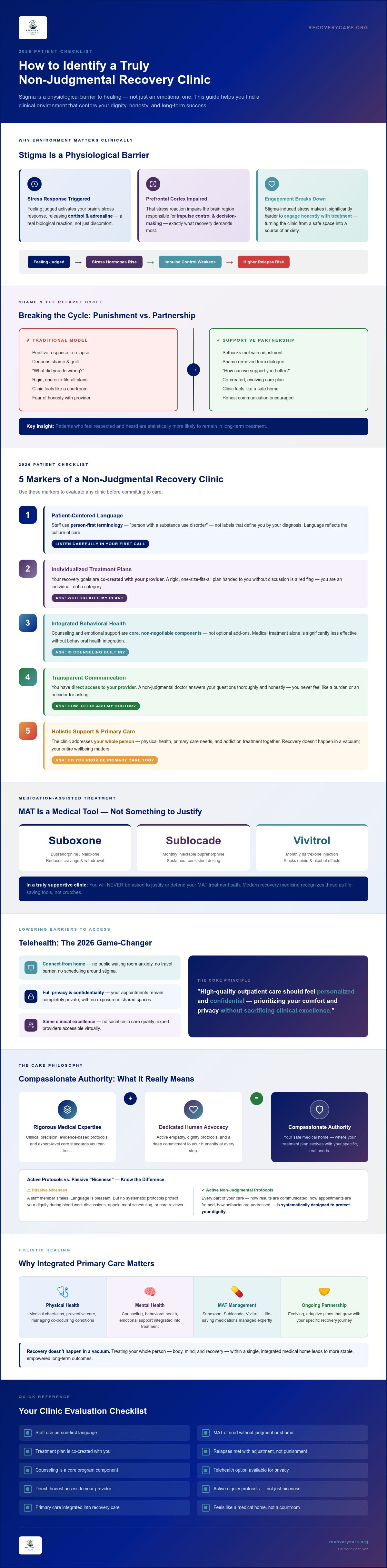
Choosing a non-judgmental recovery clinic is not just about finding a friendly doctor; it's a vital clinical decision that directly impacts your success. Stigma acts as a physiological barrier to healing. When you feel judged, your brain's stress response activates, releasing cortisol and adrenaline. This biological reaction impairs the prefrontal cortex, the area responsible for impulse control and decision-making. In a medical setting, this "stigma-induced stress" makes it significantly harder for you to engage with your treatment plan or speak honestly about your struggles.
We bridge this gap through a philosophy of compassionate authority. This approach combines the rigorous expertise of a medical institution with the heart of a dedicated advocate. There is a profound difference between passive "niceness" and active non-judgmental protocols. While a nice staff member might smile, an active protocol ensures that every part of your care, from the way your blood work is discussed to how your appointments are scheduled, is designed to protect your dignity. Patients who feel respected and heard are statistically more likely to remain in long-term treatment, as the clinic becomes a safe medical home rather than a source of anxiety.
Breaking the Cycle of Shame and Relapse
Shame is one of the most common triggers for relapse, yet traditional recovery models often use punitive measures that only deepen those feelings. If you experience a setback, a supportive medical partnership focuses on adjustment rather than punishment. We understand that recovery isn't always a straight line. By removing the fear of being "scolded" or dismissed, we create a space where you can be honest about your journey. This transparency allows our medical team to refine your care, ensuring your treatment evolves with your specific needs. It's about moving away from "what did you do wrong" and toward "how can we better support your stability?"
The Barriers Created by Traditional Healthcare Settings
Many people avoid help because traditional clinics can feel sterile, cold, or even judgmental. These environments often mirror the very systems that have historically marginalized individuals seeking recovery. High-quality outpatient care should feel personalized and confidential. For many, telehealth addiction counseling has become a game-changer in 2026. It lowers the barrier to entry by allowing you to connect with experts from the safety of your own home. This virtual option removes the anxiety of sitting in a public waiting room, providing a bridge to care that prioritizes your comfort and privacy without sacrificing clinical excellence.
The 2026 Checklist: 5 Markers of a Non-Judgmental Recovery Clinic
Finding a medical home that respects your dignity requires looking past surface-level promises. A truly non-judgmental recovery clinic integrates respect into its operational DNA. As you evaluate your options in 2026, use these five markers to ensure the environment supports your long-term health rather than your anxiety.
- Patient-Centered Language: Listen to how the staff speaks. Do they use "person-first" terminology, such as "person with a substance use disorder," rather than defining you by your diagnosis? Language reflects the underlying culture of care.
- Individualized Treatment Plans: Your recovery goals should be co-created. If a clinic hands you a rigid, one-size-fits-all plan without asking about your personal priorities, they aren't treating you as an individual.
- Integrated Behavioral Health: Medical treatment is most effective when paired with emotional support. High-quality clinics ensure that counseling for opioid addiction is a core, non-negotiable component of the program.
- Transparent Communication: You should have direct access to your provider. A non-judgmental doctor is willing to answer your questions thoroughly and honestly, without making you feel like a burden or an outsider.
- Holistic Support: Recovery doesn't happen in a vacuum. The clinic should address your physical health, including primary care needs, alongside your addiction treatment to ensure your whole person is healing.
If you're looking for a team that meets these high standards of care, you can explore our patient-first approach to see how we prioritize your dignity at every step.
Communication Style and Staff Interactions
The first phone call is often the most revealing moment. Pay attention to the tone and patience of the person on the other end. Are they rushing you, or are they taking the time to listen to your concerns? A supportive clinic operates under a strict "no-lecture" policy. This means that when you discuss your medical progress, the provider focuses on clinical data and supportive adjustments rather than moralizing your health journey. The intake process should feel like a private, respectful conversation designed to build trust, not a sterile interrogation.
Physical and Digital Environment Audit
Whether you're visiting in person or online, the environment should feel welcoming. Physical waiting rooms should offer comfort and privacy, avoiding the "punitive" feel of traditional high-security clinics. If you prefer the convenience of home, evaluate the clinic's telehealth platforms. They should be secure, user-friendly, and designed to make you feel connected rather than intimidated. Look for the presence of community resources as well. A clinic that facilitates group therapy for recovery demonstrates a commitment to building a supportive network around every patient.
Evaluating Medication-Assisted Treatment (MAT) Without Shame
Medication isn't a sign of weakness; it's a tool for stability. A non-judgmental recovery clinic recognizes that addiction is a chronic medical condition that fundamentally alters brain chemistry. When you choose suboxone treatment, you aren't "trading one addiction for another." You're using a regulated, evidence-based medication to manage withdrawal symptoms and cravings. This allows your brain to heal and return to a baseline state where you can focus on your life. If a provider suggests you're using medication as a "crutch" or pressures you to taper off before you're ready, they aren't practicing patient-centered care. True medical authority respects your timeline and your body's needs.
Shaming often hides in subtle language. You might hear a provider talk about "getting clean" from your MAT or setting arbitrary dates for when you must stop your medication. In a supportive environment, the focus remains on your functionality and well-being. Medication management is about finding the right balance to support your long-term success, ensuring that your treatment plan evolves as you do.
Understanding Your MAT Options
A clinic that offers a full spectrum of choices shows they trust you to participate in your own healing. Options like Suboxone or Subutex allow for daily routine and consistent professional oversight. For those who prefer freedom from daily dosing, a sublocade injection provides a long-acting alternative that maintains steady medication levels in your system for a full month. Alternatively, Vivitrol offers a non-narcotic approach that blocks opioid receptors entirely. Having these options ensures your care is as unique as your journey.
Defining Successful Medical Compliance
Medical compliance is a collaborative journey between patient and doctor. In a non-judgmental recovery clinic, the goal is transparency, not a perfect record. If a urine screen shows a recurrence of use, it's treated as a vital clinical data point rather than a moral failure or a reason for dismissal. This information tells the medical team that your current treatment plan might need adjustment, perhaps through a dosage change or increased behavioral support. When the fear of being "caught" is removed, you're free to be honest about your challenges. This honesty is the foundation of a successful, long-term relationship with your care team.
The Importance of Integrated Primary Care for Holistic Healing
Recovery doesn't happen in a silo. A non-judgmental recovery clinic that integrates primary care treats you as a whole person, not just a diagnosis. When addiction treatment is separated from general medicine, it often reinforces the idea that your struggle is a moral failing rather than a standard health issue. By combining these services, we normalize recovery as a vital part of your overall wellness journey. This integration eliminates the exhaustion of "doctor-hopping," where you might feel forced to hide your recovery history from a new physician for fear of being judged or denied care.
Addressing co-occurring conditions like hypertension, depression, or anxiety within the same facility provides a level of continuity that traditional models lack. When your medical team understands your full history, they can prescribe treatments that complement your recovery rather than complicate it. This unified approach creates a secure medical home where your dignity is preserved across every interaction. If you're ready to experience this level of integrated support, schedule a primary care consultation with our compassionate team today.
Routine Physicals and Diagnostic Testing
Diagnostic work, such as blood panels and physical exams, provides a clear picture of how your body is healing. These routine check-ups are more than clinical requirements; they're an act of self-respect. Monitoring your liver function, vitamin levels, and cardiovascular health ensures that your physical recovery keeps pace with your mental progress. This data-driven approach allows us to see the tangible benefits of your hard work. It also provides a stable foundation for individual counseling for addiction, as physical wellness often improves emotional resilience and cognitive clarity.
Managing Behavioral Health Alongside Primary Care
Mental and physical health are deeply intertwined. Treating the root causes of substance use often means managing untreated anxiety or chronic pain that may have led to initial use. A single medical home serves as a safety net, ensuring no part of your health is overlooked. Your behavioral health counselor and primary care provider work in tandem to ensure your treatment plan is cohesive and supportive. This synergy reduces the risk of gaps in care and provides you with a steady, reliable support system that values your long-term success in every aspect of your life.
Finding Your Safe Haven: The Recovery Care Approach
Finding a safe haven for your health is the final and most important step on your checklist. Recovery Care was founded on the belief that outpatient support should be as compassionate as it is clinically rigorous. Our mission centers on providing a non-judgmental recovery clinic where your dignity is the priority. Led by Dr. Heather Rosen, MD, our team specializes in addiction medicine that looks beyond the diagnosis to see the person. We've built a practice that feels like a medical home, offering a secure and confidential environment where you can speak openly about your goals and challenges without fear of being scrutinized.
Accessibility is a fundamental part of our commitment to inclusivity. We believe that high-quality medical care should be available to everyone, which is why we accept most major insurance plans, including Medicare and Medicaid. By removing financial and systemic barriers, we ensure that you can focus entirely on your healing. Our team is here to guide you through the intake process with the same kindness and respect you'll receive during your medical appointments. When you're ready to start, we make it simple to schedule a confidential consultation and begin your journey on your own terms.
Flexible Care: Telehealth and In-Person Options
We understand that life doesn't stop when you enter recovery. Whether you have a busy work schedule, family obligations, or concerns about public stigma, our flexible care model is designed to meet you where you are. Our virtual MAT services provide the same high standard of care as our in-person visits, allowing you to connect with your provider from the privacy of your home. This digital bridge ensures that location or transportation never stands in the way of your stability. To help you maintain your momentum, we often provide same-day or next-day appointments, ensuring that help is available the moment you decide to reach out.
A Lifetime Partner in Wellness
Recovery is a marathon, not a sprint, and we're committed to being your long-term partner in wellness. Our integrated approach means you don't have to leave us once your initial recovery goals are met. We continue to serve as a resource for your primary care and behavioral health needs, providing a steady point of contact for your overall health. Recovery Care is a compassionate authority in the field of addiction medicine. We remain dedicated to your success, offering a path toward a future that is defined by your health and potential rather than your past struggles. You deserve a medical team that stands by you with unwavering respect and clinical expertise for years to come.
Your Path to a Dignified Recovery Starts Here
Finding the right support system is about more than just medicine; it's about finding a place where you feel seen and respected. You now have the tools to identify a non-judgmental recovery clinic that prioritizes your humanity through integrated primary care and patient-first language. By choosing a medical home that values transparency over perfection, you're setting the foundation for lasting stability. It's time to move past the fear of stigma and toward a partnership that empowers your growth.
At Recovery Care, led by Dr. Heather Rosen, MD, we ensure that every interaction is rooted in empathy. Whether you utilize our confidential telehealth options or visit us in person, you'll find a team committed to your success. We proudly accept Medicaid and Medicare to make high-quality care accessible to everyone who needs it. Begin your journey in a safe, non-judgmental environment—contact Recovery Care today. You don't have to navigate this journey alone. A healthier, more secure future is within your reach, and we're ready to walk beside you every step of the way.
Frequently Asked Questions
What does "non-judgmental recovery" actually mean in a medical setting?
Non-judgmental recovery means shifting from a punitive model to a medical partnership. In a non-judgmental recovery clinic, we treat substance use disorders as chronic health conditions that require evidence-based care. We use person-first language and prioritize your dignity in every interaction. This approach removes the barrier of shame, allowing you to be honest about your health. It ensures that your treatment plan is based on clinical needs rather than moral assumptions.
Will I be judged if I have a relapse while in treatment?
You won't face judgment or punishment for a relapse. We view a recurrence of use as a vital clinical data point that indicates your current treatment plan may need adjustment. Our goal is to support your stability, not to scold you for the challenges of a chronic condition. We prioritize honesty over perfection, creating a safe space where you can discuss setbacks openly so we can refine your care together.
Can I get Suboxone treatment through telehealth at a non-judgmental clinic?
Yes, you can access Suboxone treatment and other MAT options through our confidential telehealth consultations. In 2026, virtual care is a vital tool for those who prefer the privacy of their own home or have busy schedules. It provides the same high standard of medical oversight as an in-person visit while lowering the emotional barriers of public stigma. This flexible approach ensures that your recovery journey remains both secure and accessible.
Does a non-judgmental recovery clinic take Medicaid or Medicare?
A truly non-judgmental recovery clinic must be accessible to everyone, which is why we accept Medicaid, Medicare, and most major insurance plans. We believe that financial status or insurance type should never be a barrier to receiving dignified, high-quality medical care. Our team is dedicated to providing inclusive support that values every patient's long-term success. We handle the billing complexities so you can focus entirely on your health and healing.
How do I know if my doctor is truly supportive or just being polite?
Look for active collaboration rather than just a friendly tone. A supportive doctor will co-create your treatment goals and explain the "why" behind medical decisions. They'll use person-first language and focus on your functionality and well-being rather than just checking boxes. If your provider reacts to setbacks with clinical adjustments instead of lectures or disappointment, it's a clear sign they are operating with the heart of a dedicated advocate.
What happens during the first visit to a non-judgmental recovery clinic?
Your first visit focuses on establishing trust and understanding your unique health needs. You'll undergo a comprehensive medical evaluation and a respectful intake process where we discuss your history and goals. There's no sterile interrogation; instead, it's a conversation designed to build a supportive medical home. We'll review your options for MAT and primary care, ensuring you leave with a personalized plan that prioritizes your dignity and long-term success.
Is behavioral health counseling required for MAT at your clinic?
We include behavioral health counseling as a fundamental part of our holistic care model. While medications like Suboxone or Vivitrol stabilize your brain chemistry, counseling provides the emotional and psychological tools necessary for lasting change. This integrated approach ensures we are treating the root causes of substance use alongside the physical symptoms. Our counselors work closely with our medical team to provide a seamless and deeply personalized support system for your journey.
How does integrated primary care help my recovery process?
Integrated primary care allows us to treat you as a whole person rather than a set of symptoms. By managing conditions like hypertension, depression, or anxiety in the same location as your recovery care, we provide a stable safety net. This continuity reduces the anxiety of explaining your history to multiple providers and ensures your physical health supports your sobriety. It turns our clinic into a reliable medical home for your entire wellness journey.


