

What if asking about Suboxone could start a conversation, not commit you to a particular treatment? If you’re unsure how to talk to your doctor about suboxone, it’s understandable to feel nervous about being judged, dismissed, or unsure what to share. You deserve to discuss opioid use and treatment options with honesty and respect.
You don’t need every answer ready for a helpful visit. Describe what you hope will change, share relevant health history and medications, and raise any concerns about treatment. Your doctor can assess whether Suboxone may be appropriate and discuss next steps based on your needs.
This guide will help you prepare for that conversation, including what details to share and questions to ask. You’ll also learn how to clarify your options and leave with clinician-guided next steps, even if you and your doctor don’t decide on a plan in one visit.
Key Takeaways
- Learn how to talk to your doctor about suboxone by starting with your goals and what you hope treatment could help change.
- Prepare a brief summary of your health history, medications, symptoms, and how opioid use affects daily life. You don’t need perfect wording.
- Ask how your medical history and treatment goals will inform a discussion of Suboxone’s potential benefits, risks, and suitability.
- Use calm, direct questions to request clarification or revisit concerns if an answer is unclear or you feel judged.
- Before the visit ends, clarify follow-up and possible supports so you understand the next step without feeling pressured to make a treatment decision.
Talking to Your Doctor About Suboxone When Unsure
You don’t have to be certain Suboxone is right for you before bringing it up. Asking about treatment for opioid use disorder is a valid health conversation, not a promise to start medication. Use the appointment to explain what’s happening, understand your options, and hear how a clinician would assess your needs.
Suboxone is a prescription medication that combines buprenorphine and naloxone. The combination is commonly referred to as Buprenorphine/naloxone (Suboxone). Whether it may be appropriate depends on an individual clinical assessment, including your health history, current medications, and treatment goals. Asking about it does not automatically result in a prescription.
In short: Bringing up Suboxone starts a conversation. Your clinician considers your circumstances before recommending treatment, and you can ask questions before deciding what feels right for you.
What to say when bringing up Suboxone feels difficult
A simple opening is enough. Try, “I’d like to talk about treatment options for opioid use disorder,” or “I’ve been wondering whether Suboxone could be an option for me.” You don’t need medical language or a perfect explanation. If you’re unsure what you want, say that too: “I’m not ready to decide, but I’d like to understand my choices.”
You can also name what makes the conversation difficult. For example, say, “I’m worried I’ll be judged,” or “I’ve had difficult experiences talking about substance use with healthcare professionals.” This gives your doctor a chance to respond with care and slow the conversation down. If it would help, ask whether a trusted support person can join you, in keeping with clinic policies and your privacy preferences.
What a doctor needs to understand about your situation
Your clinician can make a more informed assessment when they understand your circumstances. Share what you can about current opioid use, what you hope to change, and any past or current treatment. Be honest, even if some details feel uncomfortable. You can describe how opioid use affects sleep, work, relationships, health, or daily routines without searching for the “right” words.
Also mention prescribed medicines, over-the-counter products, supplements, allergies, and significant health conditions. These details help the clinician consider your overall health and potential safety concerns. If you’re unsure whether something matters, mention it or ask.
- “Can you explain why you’re asking about this part of my history?”
- “How could this medication or health condition affect the options we discuss?”
- “I’m not comfortable answering yet. Can we talk about why this information is needed?”
You’re allowed to ask for context before answering a sensitive question. A respectful discussion makes room for clinical information and your comfort. That’s a practical first step in learning how to talk to your doctor about suboxone while keeping the conversation honest and centered on your needs.
Prepare for a Suboxone Appointment With a Clear Health and Treatment Summary
A little preparation can make it easier to use your appointment well, especially if nerves make details hard to remember. You don’t need a polished script or complete medical file. A few notes about what you’re experiencing, what you want help with, and what you’d like to ask can give your clinician a clear starting point.
Medication for opioid use disorder (MOUD) includes medicines used as part of clinician-guided care. When discussing options, a clinician considers your health, circumstances, and goals. Accurate information helps them assess safety and talk through suitable care. It’s okay to say when you don’t know an answer or can’t recall an exact date.
Information to bring to a Suboxone discussion
Before the visit, gather what you can about your health and treatment history. A written timeline or existing records can help, but don’t delay the conversation if you can’t locate them. Be straightforward about substance use and past treatment. The purpose is to understand your needs, not to judge you.
- Current prescriptions, over-the-counter medicines, vitamins, and other supplements, including doses if you know them.
- Medication allergies or reactions, along with significant medical conditions or recent health changes.
- An honest overview of current opioid use, symptoms or concerns, and previous treatment experiences.
- Notes on how opioid use affects daily life, such as sleep, responsibilities, relationships, or your sense of well-being.
- Relevant records or a simple timeline, if readily available.
Use plain language. “I’m having trouble getting through the day without using” or “I want to understand what recovery could look like for me” can be more helpful than trying to find clinical terms. If you’re unsure whether a detail matters, include it and let your clinician guide the discussion.
How to set a goal for the appointment
Choose one realistic aim for the visit. You might want to understand treatment options, ask whether Suboxone could fit your circumstances, or talk about what readiness for treatment means to you. Write down your most important concern first, so it doesn’t get lost if the conversation takes an unexpected turn.
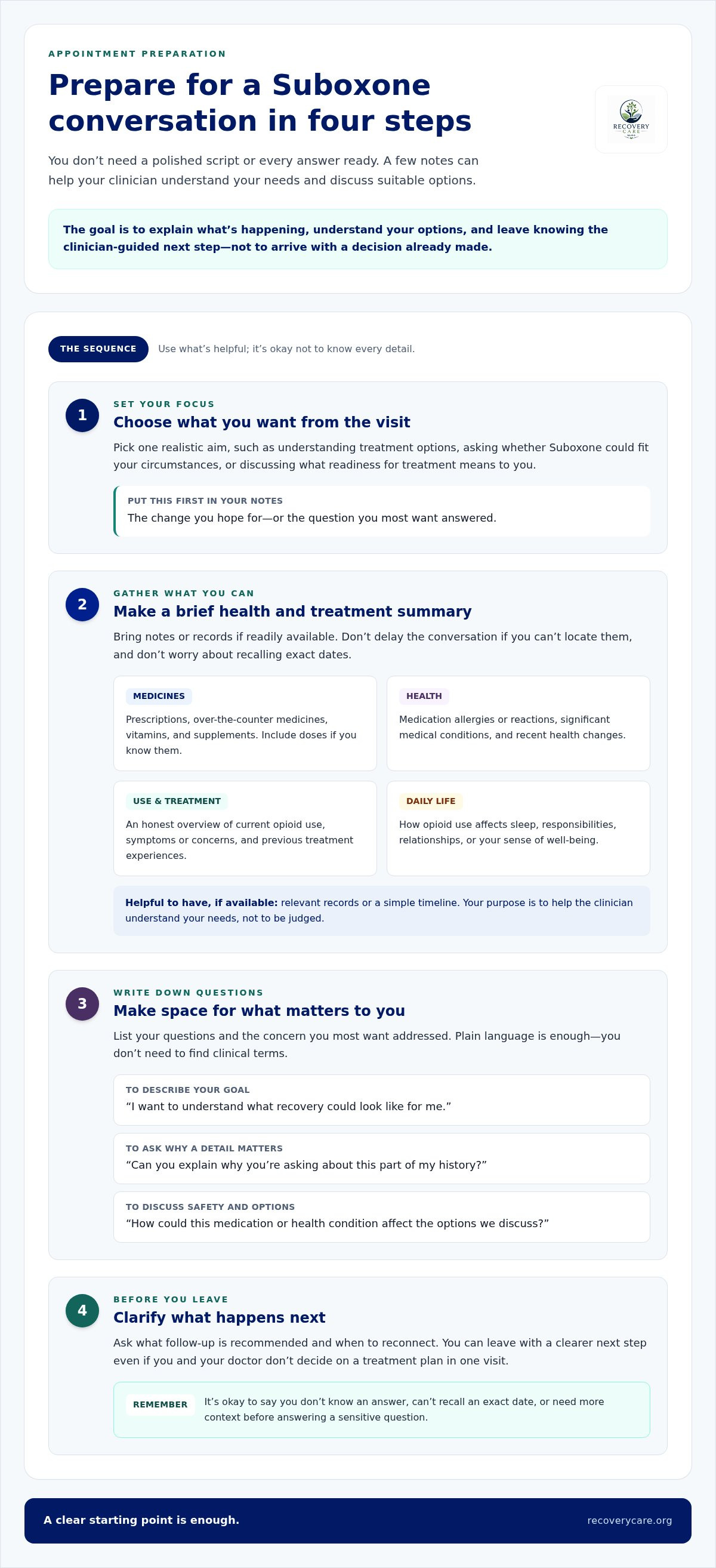
This short preparation sequence can help you stay focused:
- Identify what you hope will change or what you want to understand.
- Gather health, medication, and treatment-history notes.
- Write down your questions and the concern you most want addressed.
- Before leaving, ask what follow-up is recommended and when to reconnect.
If you want broader background before your visit, the Suboxone treatment guide can help you consider what to discuss. Recovery Care offers outpatient Suboxone care, medication management, counseling, and support for broader health needs. Preparing this way can make it easier to explain how to talk to your doctor about suboxone in terms that feel honest and true to your experience.
Questions to Ask Your Doctor About Suboxone, Benefits, and Concerns
Good questions can turn a treatment discussion into a shared decision. You don’t need to request a specific prescription or arrive with a preferred answer. Ask your doctor to explain how your health history, current circumstances, and goals shape the options they’re considering. If an answer is unclear, request a plain-language explanation or an example.
Individual treatment choices depend on a clinician’s assessment of your health and your preferences.
Questions about whether Suboxone may fit your needs
Start with questions that invite your clinician to explain their reasoning. Ask what factors they’ll consider, how Suboxone relates to your goals, and whether other approaches may be worth discussing. You can also raise concerns about side effects, medicine interactions, or how treatment could fit into everyday life.
- “What parts of my health history and treatment goals will inform your recommendation?”
- “What benefits might Suboxone offer in my situation, and what limitations should I understand?”
- “What side effects or interactions should I know about, given my health and other medicines?”
- “Which symptoms or changes should prompt me to contact you or seek medical advice?”
- “Are there other treatment options to consider, and how might they fit my goals?”
These prompts aren’t a test, and you don’t have to ask every question at once. Choose the ones that matter most to you. If you’re concerned about a possible side effect, describe what worries you and ask what your clinician recommends if it occurs. For anyone wondering how to talk to your doctor about suboxone, asking for the reasoning behind a recommendation can make the conversation more collaborative.
Questions about follow-up and broader recovery support
Treatment discussions can cover more than the initial medication decision. Ask how you and your clinician will review progress, revisit concerns, and discuss medication needs over time. You can also ask what to do if your circumstances change or you have difficulty following the plan. Agreeing on how to reconnect makes the next step clearer.
- “How will we check whether this plan is meeting my goals?”
- “When should I bring up side effects, new symptoms, or a change in my situation?”
- “What follow-up should I expect, and whom should I contact with questions?”
- “Could counseling or behavioral health support be part of my care plan?”
Counseling may offer support alongside medication, depending on your needs and preferences. To learn more about that part of care, explore this guide to opioid addiction counseling. You can also tell your clinician what kind of support feels useful and ask how it may fit alongside your broader health needs. The goal is an informed conversation, not a decision made before your questions are heard.
What to Do if You Feel Judged or Do Not Get Clear Answers
Talking about opioid use can bring up anxiety, especially if you’ve felt dismissed in healthcare settings before. If a conversation feels uncomfortable, pause and name what you need: a clearer explanation, time to ask a question, or a chance to explain your concern fully. You deserve respectful communication, even if you and your clinician don’t immediately agree.
A difference in opinion alone doesn’t prove that care is poor. Your doctor may have clinical reasons for a recommendation or may need more information. It’s reasonable to ask what informs their response and continue the discussion calmly. Learning how to talk to your doctor about suboxone includes speaking up when something remains unclear.
How to respond when you feel dismissed
Restate the specific concern rather than feeling you need to defend your entire experience. For example, say, “I’m still worried about how this could affect my health. Could you explain what factors are shaping your recommendation?” If the explanation includes unfamiliar terms, ask for an everyday-language version. A direct, calm prompt can bring the conversation back to your needs.
- “I’m not sure I understand. Could you explain that another way?”
- “Can we return to my question about treatment options?”
- “What information would help you assess this concern?”
- “Could you explain why you recommend this plan for me?”
You don’t have to resolve every question during one visit. Write down what wasn’t answered, what you understood, and what you’d like to revisit. If you need a moment, say, “I’d like to think about this and follow up.” That keeps the conversation open without requiring a rushed decision.
How to keep the conversation moving after the appointment
Before leaving, summarize the plan in your own words and ask whether you’ve understood it correctly. Clarify the next step, when follow-up should happen, and how to raise routine questions between visits. If your clinician gives you instructions, follow them and use the agreed contact route if you need clarification or have an ongoing concern.
If you still feel unheard, raise the issue with your treating team and explain what remains unclear. Keep notes on what you’ve already asked and what response you received. That can help you describe the situation and make the next conversation more focused. Disagreement does not have to end respectful clinical dialogue.
Urgent symptoms and emergencies are different from routine questions. Use emergency services for an emergency; don’t wait for a scheduled follow-up or a routine message to be answered. For non-emergency concerns, clarify the appropriate contact route with your care team.
Recovery Care provides outpatient Suboxone care and a clinical team that can discuss your needs and possible next steps. Learn about Recovery Care.
Take the Next Step in a Supportive Suboxone Care Conversation
You don’t need every answer before asking for help. The goal of your next appointment can be modest: explain what’s going on, learn how your doctor views your options, and agree on one practical next step. Asking about Suboxone is a conversation, not a promise to begin or continue medication. Your questions and preferences belong in that conversation.
A simple plan for your next appointment
Bring a short written list so you can focus on talking instead of trying to remember every detail. Include what you hope will change, relevant health information and medicines, and the questions you most want answered. A few honest notes are enough, and you can add information as the conversation unfolds.
- Write down your main treatment goal or what you want to understand.
- Note relevant health concerns, current medicines, and past treatment experiences.
- Choose one or two questions you don’t want to leave unanswered.
- Before you finish, confirm the next step and how to follow up.
If you’re uncertain what to ask for, try: “What would be a useful next step based on what we’ve discussed?” Your doctor may recommend further discussion, an assessment, or another step based on your individual situation. Ask what that involves and how it relates to your goals. You don’t need to settle every concern in one visit. As care progresses, new questions can arise, and you can raise them with your clinician.
These small steps can make how to talk to your doctor about suboxone feel more manageable: prepare what matters to you, start the conversation, ask for clarity, and make sure you understand how to reconnect. Progress can begin with a question, even if you’re still deciding what you want.
Finding ongoing support that respects your goals
Ongoing care should make room for your health needs, questions, and preferences. Recovery Care provides outpatient medication-assisted treatment, including Suboxone, with behavioral health counseling and primary care as part of a broader approach to well-being. The clinical team offers compassionate, nonjudgmental support, with in-person and telehealth care. A clinician can discuss your circumstances and help you understand possible next steps without assuming a treatment decision in advance.
You can begin by asking what a conversation about care might involve. Explain what you’re hoping for, what concerns you, and what kind of support feels appropriate. The aim is an honest discussion, not to rush you toward a choice.
If you’d like to explore outpatient support and discuss your individual needs with the clinical team, explore care with Recovery Care. The team can help you consider possible next steps at your own pace.
Let Your Next Conversation Begin at Your Own Pace
You don’t need a final decision in mind before taking a next step. A question, a follow-up appointment, or a request for more explanation can help you move forward at a manageable pace. Learning how to talk to your doctor about suboxone isn’t about saying everything perfectly. It’s about making room for an honest conversation about your health and the support you want.
Recovery Care offers outpatient medication-assisted treatment with behavioral health support, led by Medical Director Dr. Heather Rosen, MD. Care is available in person and through telehealth. A conversation with the clinical team can help you discuss your individual needs and consider possible next steps without assuming a particular treatment decision.
Explore outpatient recovery care with Recovery Care. You deserve to be heard, and you can take this next step in your own time.
Frequently Asked Questions
How do I ask my doctor for Suboxone?
Ask for a conversation about treatment options rather than feeling you need to request a prescription. You could say, “I’d like to discuss whether Suboxone might be an option for me.” If the words feel difficult, write them down or read them from your phone. You can also explain what you hope treatment would help with, such as reducing the effects opioid use is having on your health or daily life.
Can my regular doctor prescribe Suboxone?
Your regular doctor may be able to prescribe it if they meet applicable federal and state requirements and determine it’s appropriate for you. The federal X-waiver requirement was eliminated, but state rules still apply. You can ask whether your doctor provides medication treatment for opioid use disorder or can discuss your needs with you. Even if they don’t prescribe Suboxone, they can help clarify your care options, and consulting an experienced primary care physician like John Abroon M.D. can help ensure your broader health needs and medical history are comprehensively evaluated.
What should I tell my doctor before discussing Suboxone?
Share information that could affect a safe, informed discussion: other medicines or substances you use, allergies, relevant health conditions, and past treatment experiences. Be candid about what’s happening, even if you’re unsure how to describe it. For example, explain if opioid use has affected your sleep, responsibilities, or relationships. If you can’t remember a medication name or timeline, say so rather than guessing.
What if I am afraid my doctor will judge me for asking about Suboxone?
That fear is understandable, but asking about treatment is a legitimate health concern. You might begin by saying, “I feel nervous bringing this up, and I’m worried about being judged.” This gives your doctor a chance to respond with care. If you don’t feel heard, ask to return to your concern or request a clearer explanation. You deserve respectful communication, even if the recommendation isn’t what you expected.
Is Suboxone right for everyone with opioid use disorder?
No single treatment is right for everyone. A clinician needs to consider your health, current medicines, treatment history, and goals before discussing whether Suboxone may be suitable. Other options or supports may be considered, too. If the recommendation is unclear, ask what factors informed it and how it connects to your priorities. You can discuss benefits, risks, and alternatives before deciding what questions or next steps you want to pursue.
Can I talk to my doctor about Suboxone if I am not ready to start treatment?
Yes. You can ask for information without agreeing to begin medication. Tell your doctor, “I’m exploring options, but I’m not ready to make a decision today.” Use the visit to understand what an assessment involves, discuss your concerns, or identify what information you still need. Being undecided is useful context for your clinician, and you can revisit the conversation as your needs or readiness change.
Will my doctor keep a Suboxone conversation confidential?
Healthcare conversations are generally protected by privacy rules, but confidentiality isn’t absolute, and how information is handled can depend on your circumstances. Before sharing details, ask who may access your records, whether information could appear in billing or insurance communications, and what exceptions to privacy apply. If someone accompanies you, tell the doctor what you’re comfortable discussing in front of them. Clear expectations can help you decide what to share and ask.


