

Could protecting your teeth put your recovery at risk? If you’re worried about suboxone and dental problems, it’s understandable to feel caught between caring for your oral health and continuing a treatment that helps you. You don’t have to make that choice on your own.
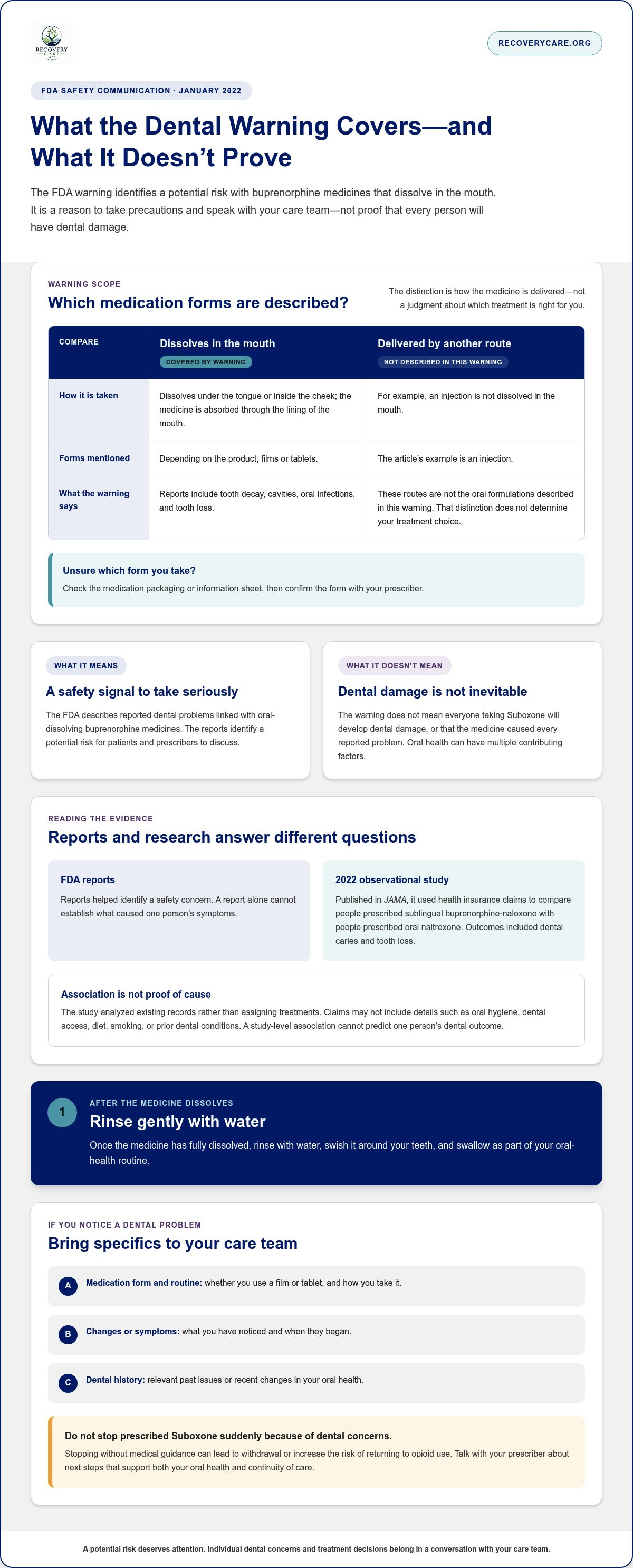
The FDA’s January 2022 warning describes reports of tooth decay, cavities, oral infections, and tooth loss associated with buprenorphine medicines that dissolve in the mouth. It’s an important safety signal, but it doesn’t mean everyone taking Suboxone will develop dental damage, or that the medication is the only possible cause. The warning is a reason to take preventive steps and raise concerns with your care team, not to stop treatment abruptly.
This article explains what the FDA warning does and doesn’t say, why oral buprenorphine may affect dental health, and what you can do to help protect your teeth, including rinsing with water after the medication dissolves and keeping up with dental checkups. You’ll also find practical ways to talk with your prescriber and dentist, so you can address your concerns while making treatment decisions with support.
Key Takeaways
- The FDA warning covers buprenorphine medicines dissolved under the tongue or inside the cheek; it signals a risk, not a certainty that you’ll develop dental damage.
- Research on suboxone and dental problems can show an association, but an observational study cannot prove what caused an individual person’s tooth decay.
- Don’t stop Suboxone suddenly because of dental concerns. Talk with your prescriber about a safe plan that supports both your oral health and recovery.
- Once the medicine has fully dissolved, gently rinse with water, swish it around your teeth, and swallow as part of your oral-health routine.
- Prepare to discuss your medication form, dosing routine, symptoms, and dental history so your care team can help you consider next steps.
Suboxone and Dental Problems: What the Warning Means
If you’re worried about your teeth while taking Suboxone, your concern deserves attention. You don’t have to figure out what the warning means or what to do next on your own. The FDA’s January 2022 communication describes reported dental problems with buprenorphine medicines that dissolve in the mouth. The reported outcomes include cavities, tooth decay, oral infections, and tooth loss.
A warning signals a potential safety risk that patients and prescribers should take seriously. It doesn’t predict that every person taking the medication will experience dental damage, and it doesn’t establish that the medication caused every reported problem. Oral health can be affected by multiple factors, so a new symptom or dental diagnosis deserves an individualized conversation.
Which Suboxone formulations are covered by the dental warning?
The warning concerns buprenorphine medicines that dissolve under the tongue or inside the cheek. These are called transmucosal medicines because the medication is absorbed through the lining of the mouth. Depending on the product, they may come as films or tablets. For background on buprenorphine and naloxone, see What is Buprenorphine/Naloxone?
Medicines delivered by other routes, such as an injection, aren’t dissolved in the mouth and therefore aren’t the oral formulations described in this warning. That distinction doesn’t determine which treatment is right for you. If you’re unsure what form you take, check the medication packaging or information sheet and confirm it with your prescriber.
Does a dental warning mean Suboxone is unsafe?
No. The FDA identifies a risk with oral-dissolving buprenorphine while recognizing buprenorphine’s important role in treating opioid use disorder. A warning is meant to support informed decisions and sensible precautions, not to tell every patient to stop a medication that may be helping them.
A reported safety risk deserves attention, but it doesn’t mean dental damage is inevitable for you. Your personal risk and treatment needs are best considered with your care team, especially if you’ve noticed sensitivity, pain, visible changes, or signs of infection.
If a dental problem has come up, share the details rather than making a medication change on your own. It may help to tell your prescriber:
- Whether you use a film or tablet, and how you take it.
- What dental changes or symptoms you’ve noticed and when they began.
- Any relevant dental history or recent changes in your oral health.
Don’t stop prescribed Suboxone suddenly because of dental concerns. Stopping without medical guidance can lead to withdrawal or increase the risk of returning to opioid use. Your prescriber can help you discuss the concern and consider next steps while supporting continuity of care.
What Research Says About Buprenorphine and Tooth Decay
Reports of dental problems and clinical studies are related, but they are not the same kind of evidence. Understanding the difference can help you take the risk seriously without assuming that Suboxone is the definite cause of a particular dental problem. The FDA’s FDA Warning on Suboxone and Dental Problems describes reports made to the agency. Those reports helped identify a safety concern, but a report alone can’t establish what caused an individual person’s symptoms.
A 2022 study published in JAMA used health insurance claims to examine dental outcomes among people with opioid use disorder. Researchers compared people prescribed sublingual buprenorphine-naloxone with people prescribed oral naltrexone, a different medication for opioid use disorder. They assessed outcomes that included dental caries and tooth loss. Because the researchers analyzed existing records rather than assigning treatments, the study was observational.
That distinction matters. An association means an outcome appeared alongside an exposure in the data. It doesn’t, by itself, show that the medication caused the outcome. Claims records can also miss details about oral hygiene, dental access, diet, smoking, prior dental conditions, and other factors that may influence oral health.
How might oral buprenorphine affect dental health?
With a medicine that dissolves in the mouth, the teeth and oral tissues have repeated contact with the medication as it dissolves. Researchers and clinicians have considered possible explanations, including the medicine’s acidity or changes in saliva. These are potential contributing mechanisms, not proof that one specific process explains every case.
Practical FDA precautions are distinct from these hypotheses. They address how to reduce contact with medication residue after a dose; they don’t confirm why dental problems may occur or guarantee prevention. Your formulation, dental history, and symptoms all matter when discussing the concern with your care team.
What can observational research tell patients?
Observational research looks for patterns in information already collected, such as insurance claims. It can identify a possible relationship worth studying, but it can’t control every difference between the people in each comparison group. A study-level association can highlight a risk to discuss, but it can’t predict one person’s dental outcome.
Keep the evidence categories separate: FDA reports identify a safety signal, observational studies examine patterns, and lawsuits contain allegations that are considered through a legal process. None of these alone diagnoses the cause of your dental condition. If questions about your medication are affecting your treatment, a conversation about your Suboxone treatment care can help you consider concerns without making changes on your own.
Should You Stop Suboxone Because of Dental Problems?
If you’ve noticed a tooth problem and wonder whether stopping Suboxone is the safest choice, pause before changing your medication. Dental concerns are real and deserve timely attention, but stopping prescribed Suboxone suddenly or without medical guidance can bring withdrawal symptoms and increase the risk of returning to opioid use. That can put your recovery and overall health at risk.
There isn’t one medication decision that fits everyone. Your prescriber can help weigh your dental symptoms, treatment benefits, health history, and preferences together. If you’re concerned about suboxone and dental problems, raising the issue promptly gives your care team a chance to discuss it while keeping recovery support in view. Don’t lower, skip, or stop doses on your own.
How should you weigh dental concerns against recovery?
Your concern about your teeth isn’t a reason to feel blamed or dismissed. Tell your prescriber what you’ve noticed and how it affects you. Together, you can review your symptoms, the formulation you take, your treatment goals, and any concerns about continuing. The aim is a thoughtful, individualized plan that addresses oral-health concerns while maintaining appropriate support for opioid use disorder.
Medication decisions should be made with your prescribing clinician, not based on online claims or fear alone. A dental symptom doesn’t automatically mean Suboxone caused it, and a possible medication-related risk doesn’t make it wise to interrupt treatment without guidance. If a change is being considered, your prescriber can explain the potential risks and options that fit your circumstances. Avoid switching to another medication or changing your dose without their direction.
When should you contact your prescriber?
Reach out to your prescriber if you develop new tooth pain, sensitivity, visible decay, or signs of a mouth infection. Make contact promptly if symptoms interfere with eating, sleeping, or taking medication as prescribed. A dentist can assess the dental problem, while your prescriber can help you consider medication-related questions; sharing information between your care professionals may help coordinate decisions.
Seek timely assessment from an appropriate medical or dental professional if pain, swelling, or other symptoms are severe or rapidly worsening. Don’t wait for a routine medication appointment if your condition is getting worse. When you contact your prescriber, briefly explain what changed, when it started, and whether it affects eating, sleep, or your dosing routine. Clear details can help the conversation focus on your immediate concern and next steps.
You deserve care that takes both your oral health and recovery seriously. Keep taking medication as prescribed unless your clinician advises otherwise, and let your care team know what’s happening so you can decide on next steps with support.
How to Protect Your Teeth While Taking Suboxone
A steady mouth-care routine can support your dental health while you continue prescribed treatment. These steps can reduce avoidable exposure and help you spot concerns sooner, but they can’t guarantee that dental problems won’t occur. Follow any individualized instructions from your dental professional, and keep your prescriber informed if oral symptoms make taking medication difficult.
What should your daily mouth-care routine include?
After each dose, let the medicine dissolve fully before rinsing. The FDA’s post-dose guidance can be remembered as a simple sequence: let it dissolve, rinse gently with water, swish the water around your teeth and gums, then swallow. Wait at least one hour after dosing before brushing your teeth.
Between doses, maintain consistent oral hygiene. Brush regularly with fluoride toothpaste and clean between your teeth with floss or another interdental cleaner. Keep routine dental visits so a dental professional can assess your oral health and recommend care that fits your needs. If you have questions about timing or your specific formulation, raise them with your prescriber rather than changing how you take your medication on your own.
For an easy-to-follow routine, consider these practical reminders:
- Allow the medicine to dissolve completely before rinsing.
- Gently rinse with water, swish around your teeth and gums, and swallow.
- Wait at least one hour before brushing after your dose.
- Brush with fluoride toothpaste, clean between teeth, and attend regular dental checkups.
These steps are supportive prevention, not a promise that cavities or other problems won’t develop. Your dental professional may tailor advice based on your oral health, existing dental work, and other needs.
Which symptoms should prompt a dental visit?
Arrange a dental assessment if you have persistent tooth pain or sensitivity, visible cavities or tooth changes, gum swelling, or signs that could indicate an oral infection. Don’t try to diagnose the cause yourself. A dental professional can examine the area and advise you on appropriate care.
Early evaluation can help identify a problem before it becomes harder to manage. If symptoms are severe or worsening quickly, seek timely assessment. If pain or another oral concern affects eating, sleeping, or taking your medication as prescribed, tell both your dental professional and your prescriber. That information can help them coordinate advice without you having to make medication decisions alone.
Concerned about suboxone and dental problems? Recovery Care’s Suboxone treatment support can help you discuss medication concerns with your care team while keeping your treatment needs in view.
Talking With Your Prescriber About Suboxone and Dental Health
Bringing up a dental concern doesn’t mean you’re questioning your recovery or doing anything wrong. It’s a responsible part of caring for your health. A clear, practical conversation can help your prescriber understand what’s happening and discuss how to address your oral-health concern while maintaining treatment support. Don’t stop or change your medication on your own while waiting for that conversation.
What information should you bring to the conversation?
You don’t need to have all the answers or prove what caused a symptom. A brief account of what you’ve noticed can help your prescriber understand the concern and consider appropriate next steps. If it’s helpful, write down a few details before your appointment:
- When the symptom began, where you feel it, and whether it’s getting worse.
- The medication name and formulation, such as a film or tablet, and your usual dosing routine.
- Any recent changes to how you take the medication, along with relevant dental history.
- Your usual oral-care habits and whether symptoms affect eating, sleeping, or taking medication.
Be open about what’s been difficult, even if your routine hasn’t been consistent. The goal is to understand your needs, not to judge you. You might ask, “How can I continue treatment while I address this specific dental concern?” or “What should I do if the symptom changes?” If you’re already seeing a dental professional, sharing their recommendations with your prescriber may help inform the discussion.
For broader context about medication-assisted treatment and recovery, read this Suboxone treatment guide. It can help you prepare questions about your care, but personal medication decisions should be discussed with your prescribing clinician.
How can whole-person care support recovery?
Recovery Care provides outpatient Suboxone treatment and primary care support. Primary care can be part of a broader approach to your health and can complement medication management, but it doesn’t replace an evaluation or treatment from a dental professional. Recovery Care also offers behavioral health counseling as part of care that supports broader health needs.
Concern about suboxone and dental problems is worth bringing forward. You can discuss your symptoms, treatment preferences, and questions with your care team without making abrupt changes by yourself. If you’d like support with your treatment, connect with Recovery Care to talk about your next step.
Take the Next Step With Confidence
You don’t have to resolve every question about your teeth and treatment at once. Start with one practical step: write down the concern you most want your prescriber to address, then bring it into a conversation about your care. A thoughtful plan can make room for your oral-health concerns while keeping your recovery goals in view.
Recovery Care offers outpatient Suboxone treatment and medication management led by Medical Director Dr. Heather Rosen, MD, with primary care and telehealth consultations available. Although dental concerns need assessment by a dental professional, your treatment team can help you discuss medication questions as part of your broader health needs.
If suboxone and dental problems have left you unsure what to do next, you deserve support without judgment or pressure. Connect with Recovery Care for compassionate treatment support and take the next step at your own pace.
Frequently Asked Questions
Can Suboxone cause tooth decay or tooth loss?
Dental problems, including cavities, tooth decay, oral infections, and tooth loss, have been reported with buprenorphine medicines that dissolve in the mouth. These reports and research findings raise a concern, but they can’t predict what will happen to any one person. If you notice a change, note when it started and which teeth are affected, then discuss it with a dental professional and your prescriber. Don’t stop treatment suddenly on your own.
Is the dental risk the same for every form of buprenorphine?
No. The FDA warning focuses on buprenorphine medicines dissolved under the tongue or held against the inside of the cheek, where the mouth has direct contact with the medication. That describes the route of administration, not an identical risk for every person or formulation. Check your medication information to identify how yours is taken, and review it with your prescriber if anything is unclear.
Can dental problems happen even if I never had cavities before?
Yes. The FDA has noted reports of serious dental problems among people without a prior history of dental issues. A healthy dental history doesn’t guarantee you’ll avoid future problems, but it also doesn’t mean damage is certain. Keep track of new changes, such as sensitivity when drinking something cold, and mention them at a dental visit rather than waiting for your next routine checkup.
Should I stop taking Suboxone if my teeth hurt?
No. Don’t stop or change your prescribed medication without first speaking with your prescriber. Sudden discontinuation can cause withdrawal and may increase the risk of returning to opioid use. Tooth pain needs timely dental assessment, while your prescriber can help consider medication and recovery needs together. If symptoms are severe or rapidly worsening, seek prompt medical or dental assessment rather than waiting for a routine appointment.
Does naloxone in Suboxone cause tooth decay?
The FDA warning concerns buprenorphine medicines that dissolve in the mouth; it doesn’t establish that naloxone itself causes dental problems. Suboxone contains both buprenorphine and naloxone, but the product name alone can’t tell you which ingredient may be relevant to an individual concern. Bring the exact medication name and formulation to your prescriber and ask how the warning applies to your treatment.
How long should I wait to brush my teeth after taking Suboxone?
Wait at least one hour after the medicine has completely dissolved before brushing, following FDA guidance. After dissolution, take a sip of water, gently swish it around your teeth and gums, then swallow. If you take a dose at a time that makes this routine difficult, ask your dental professional or prescriber how to fit the guidance into your schedule without changing your medication routine on your own.
What should I tell my dentist if I take Suboxone?
Tell your dentist you take buprenorphine-naloxone and explain whether it’s a film, tablet, or another formulation. Share when symptoms began, where you feel them, and whether you’ve noticed sensitivity, pain, cavities, or gum changes. Mention your usual oral-care routine and relevant dental history, too. This context can help inform your dental assessment. Direct medication questions to your prescriber, and don’t change treatment before the visit.


