

What if changing Suboxone doctors could be a careful handoff rather than a sudden change to your treatment? If you’re wondering how to switch suboxone doctors, it’s understandable to worry about running low on medication, gathering records, or being asked to change a plan that’s working for you. A thoughtful transition starts with a clinical conversation, not an assumption that your care will automatically change.
You can take practical steps to make the process more manageable. Before your first appointment, organize details about your current treatment and prescriptions, and tell the new clinician about any timing concerns. Your treatment history gives them a clearer picture of your needs, while clinical judgment guides decisions about next steps.
This guide explains how to plan a Suboxone care transfer, what information to prepare, and how to discuss your goals and concerns at the first visit. Recovery Care provides outpatient Suboxone treatment, in-person care, telehealth consultations, and behavioral health counseling. Here’s how to approach the handoff with clarity and work toward a respectful, sustainable care arrangement.
Key Takeaways
- Changing Suboxone doctors can be a reasonable step when access, communication, insurance, or appointment needs change.
- Learn how to switch suboxone doctors with a clear sequence for contacting the new care team, sharing records, and completing an evaluation.
- A new clinician assesses your history and current circumstances. A transfer doesn’t automatically mean your dose or treatment plan will change.
- Prepare identification, insurance details, medication and pharmacy information, relevant records, and questions about follow-up.
- Outpatient Suboxone treatment, behavioral health counseling, and primary care can support different aspects of your ongoing needs.
Why switch Suboxone doctors, and when should you start planning?
Changing clinicians is a reasonable care decision. Your needs, schedule, insurance, or circumstances can change, and you don’t have to prove that something is wrong before exploring a different care arrangement. Planning ahead gives you more time to coordinate the transition, though it can’t guarantee there won’t be a delay. Keep treatment clinician-guided: don’t stop taking Suboxone or change your dose without medical direction.
Suboxone contains buprenorphine and naloxone. For a general overview of the medication, Buprenorphine/naloxone (Suboxone) explains its use in opioid use disorder treatment. Discuss your own treatment decisions with a qualified clinician who can consider your history and current needs.
What can prompt a change in Suboxone care?
A care transition can begin with a change in access, fit, or treatment needs. For example, a long commute or limited appointment availability may make consistent follow-up harder. An insurance change can affect how you access care, while a preference for telehealth or in-person visits may lead you to seek a different appointment format. You may also want more communication or support that better reflects your circumstances.
It can help to name what you hope will be different. Is your main concern scheduling, how your questions are addressed, coordination with behavioral health support, or a change in your daily routine? You don’t need to criticize your current clinician. Explaining what would help you feel supported gives a new care team useful context and helps you decide whether a different arrangement fits your needs.
Why is it better to plan before medication runs low?
A transition may involve more than booking a visit. The new care team may need time to arrange an intake, receive or review records, and understand your treatment history before making clinical decisions. Scheduling and record coordination take time, and the timeline varies. Starting while your current care plan is still active gives you more opportunity to discuss the handoff before your next prescription becomes urgent.
- Check when your next appointment and prescription are due.
- Contact the new care team early to discuss intake and what information may help with the clinical review.
- Allow time to request relevant records and prepare questions about follow-up or communication.
If your prescription is close to running out, seek timely medical guidance rather than waiting for the transition to resolve itself. Clearly tell the care team about the timing so they can understand your concern and advise you. Don’t take extra medication, skip doses, or alter your treatment to manage the change on your own. Learning how to switch suboxone doctors starts with planning a clinician-guided conversation while there’s still time to coordinate next steps.
How to switch Suboxone doctors: the care-transfer steps
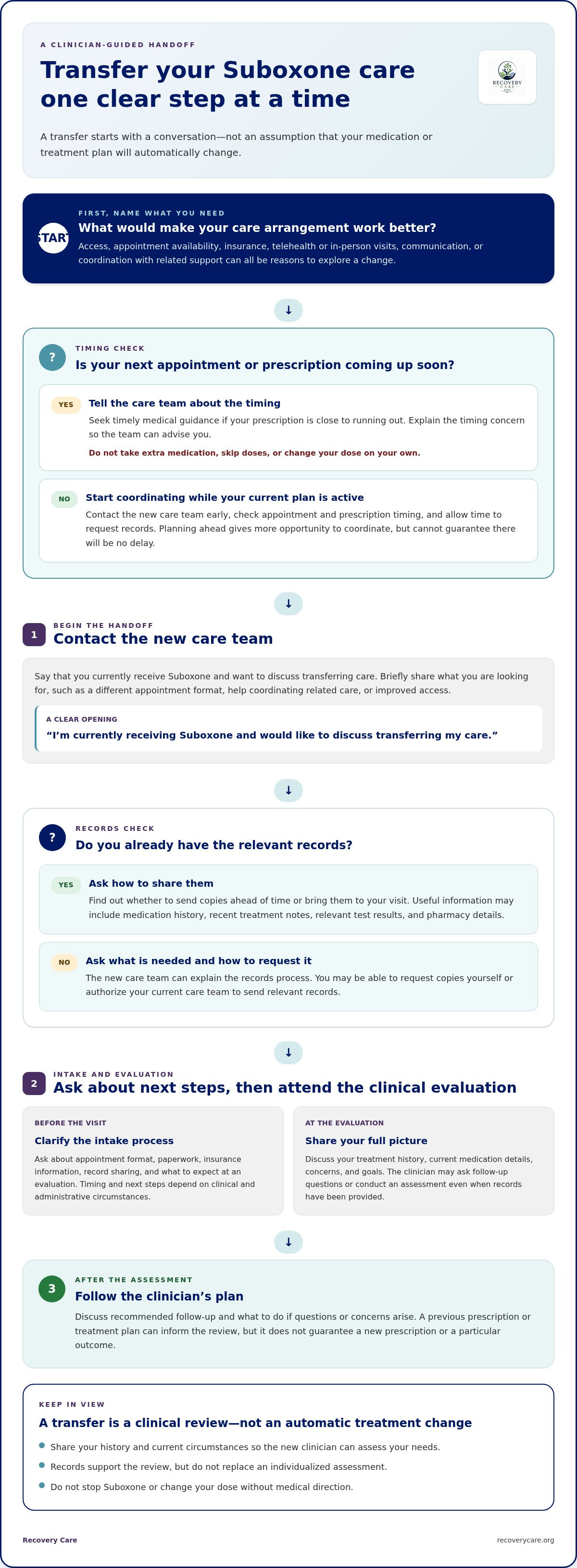
A clear sequence can make a care transfer easier to manage, but intake processes and patient needs differ. The new clinician will review your history and make independent treatment decisions. A previous prescription or treatment plan can inform that review, but it doesn’t guarantee a new prescription or a particular outcome.
- Contact the new care team. Say that you’re currently receiving Suboxone and want to discuss transferring care. Briefly explain what you’re looking for, such as a different appointment format, help coordinating related care, or a change in access.
- Ask about intake and next steps. The first conversation may cover appointment format, intake paperwork, insurance information, and what to expect at an evaluation. Ask how to request or authorize the release of relevant records. Appointment timing and next steps depend on clinical and administrative circumstances.
- Gather and arrange records. Find out which records could help and how to share them. Depending on the records process, you may be able to request copies yourself or authorize your current care team to send them.
- Attend the clinical evaluation. Share your treatment history, current medication details, concerns, and goals. The clinician may ask follow-up questions or conduct an assessment even if you’ve provided records.
- Follow the clinician’s plan. Discuss recommended follow-up and what to do if questions or concerns come up. Don’t change your medication based on assumptions about the new plan.
What happens when you contact a prospective Suboxone doctor?
The first contact is a chance to explain your situation and understand the intake process, not a guarantee of a specific appointment or prescription. Be direct: “I’m currently receiving Suboxone and would like to discuss transferring my care.” Mention when your next appointment or prescription is due so the team understands what needs attention. For background on buprenorphine treatment, see SAMHSA’s buprenorphine information.
How do records and clinician coordination fit into the transfer?
Useful records may include your medication history, recent treatment notes, relevant test results, and pharmacy details. Ask what the new care team needs, how to authorize sharing, and whether to bring copies to your visit. Records help a new clinician understand your treatment history, but they don’t replace an individualized assessment. The new clinician evaluates your circumstances and makes treatment decisions independently.
If you’re considering a transfer, you can discuss outpatient Suboxone care with Recovery Care. Learning how to switch suboxone doctors means preparing for a coordinated clinical review while recognizing that next steps depend on your individual evaluation.
Will switching Suboxone doctors change your dose or treatment plan?
Not automatically. Changing clinicians doesn’t, by itself, mean your dose will change or that you must start treatment over. At the same time, a new clinician needs to assess your situation and make independent decisions about care. Your current plan is important context, but it doesn’t predetermine what the new clinician will recommend.
Medication decisions depend on your treatment history, current circumstances, and the clinician’s evaluation. If you’re worried about a change, say so openly. Explain what’s working, what feels difficult, and what you hope to maintain or address. A respectful conversation can include your preferences while leaving prescribing decisions with the clinician.
What should you expect during the new clinician’s review?
The clinician may ask about your current medication and how you take it, your treatment history, symptoms, other medications, and relevant health concerns. These questions help build an up-to-date picture of your needs. Even if you’ve shared records, the clinician may need to clarify details or ask about changes since your last visit. The review supports an individualized plan, not a predetermined outcome.
It’s understandable to wonder whether you’ll have to repeat every step of treatment. A transfer doesn’t automatically mean starting from the beginning, but the clinician decides what assessment is appropriate. Be as accurate as you can, including details you may feel unsure about. If you don’t know an answer, say so rather than guessing.
How can you speak up about your current plan?
You know how treatment fits into your day-to-day life. Share the benefits you’ve experienced, any side effects or concerns, and what you’d like your care to support. For example, you might explain that your current approach has felt stable but appointment access or follow-up communication has been challenging. Clear, specific examples help the clinician understand your perspective.
- What aspects of your current treatment are helping?
- Have you noticed side effects, new symptoms, or other concerns?
- What would you like to improve, such as communication or follow-up?
- What questions do you have about the clinician’s recommendations?
If the conversation feels difficult, write down your priorities beforehand and bring the list to your appointment. Ask the clinician to explain the reasoning behind a recommendation and discuss any concerns respectfully. Sharing your goals matters, but don’t adjust your dose or stop medication on your own while waiting for answers. Ask the clinician for guidance about medication questions or concerns.
Understanding how to switch suboxone doctors includes recognizing the difference between a handoff and an automatic treatment change. Your history and preferences should inform the conversation, while the clinician’s assessment guides medical decisions. You deserve to be heard, and it’s appropriate to ask questions as you work together on a plan suited to your current needs.
What to prepare before your first appointment with a new Suboxone doctor
A little preparation can help you use the first visit to explain your needs and ask practical questions. You don’t need a perfect file or a detailed account of every appointment. Bring what you have, note what you’re unsure about, and be honest about your current treatment so the clinician can make an informed assessment.
Use this checklist as a starting point:
- Identification and insurance: Bring identification and your insurance information. Coverage and benefits vary by plan and individual circumstances, so don’t assume a particular service or visit will be covered.
- Medication and pharmacy details: Write down your current medication, how you take it, the name of your current prescriber, and the pharmacy you use. Bring medication packaging or a current medication list if available.
- Relevant records: Gather treatment notes, medication history, relevant test results, and other health records you can access. Ask about the process for requesting or authorizing records to be shared.
- Health information: Note other medications, allergies, relevant health history, and any current symptoms or concerns.
- Your questions and priorities: Prepare a short treatment timeline and a list of topics to discuss, such as follow-up, communication, or appointment format.
Which information can make an intake conversation easier?
A concise timeline can keep the conversation clear: when you began treatment, any notable changes, and what your current routine looks like. Include the name of your current prescriber and describe what’s helping or challenging you now. Share health information honestly, including other medications, allergies, and concerns, even if you’re unsure whether a detail is relevant. The clinician can ask follow-up questions and decide what matters for your care.
What questions can you bring to the first visit?
Writing questions down can help if you feel nervous or worry you’ll forget something. Consider asking how follow-up appointments and communication fit into the care plan, how records are coordinated, and how prescription-related questions are handled. You can also discuss whether in-person or telehealth visits suit your circumstances. Telehealth eligibility and visit requirements can depend on individual circumstances and applicable rules, so the clinician can discuss what applies to you.
If you have insurance, bring your plan details and ask how coverage and benefits relate to your care. Recovery Care accepts most major insurance plans, Medicare, and Medicaid, though coverage and eligibility depend on individual circumstances. Bringing your information helps support that conversation, but it can’t establish a particular coverage outcome in advance.
Preparing these details is a practical part of how to switch suboxone doctors and gives the new clinician a clearer picture of your needs. Discuss your Suboxone care transition with Recovery Care and bring your questions to the conversation.
How Recovery Care can support a Suboxone care transition
Considering a change in care can bring up practical questions and personal concerns. You may want to explain what’s working in your current treatment, what you hope will be different, and what support would make ongoing care more manageable. At Recovery Care, you can discuss your needs with the clinical team. The conversation doesn’t assume your treatment plan will change or promise a particular prescription or outcome.
Recovery Care provides outpatient Suboxone treatment, behavioral health counseling, and primary care. These services provide an opportunity to discuss medication treatment alongside related health and support needs. Care is available in person and through telehealth, with the appropriate format depending on individual circumstances.
What support can Recovery Care provide?
Medical Director Dr. Heather Rosen, MD, leads the practice. You can discuss your current treatment, questions, and goals with the clinical team. Recovery Care provides outpatient treatment and related support, including behavioral health counseling and primary care. Treatment recommendations depend on an individualized clinical assessment, so the conversation begins with understanding your circumstances rather than assuming a specific plan.
It may help to identify what you want the new care arrangement to support. For example, you might want to talk about communication, appointment format, or how behavioral health counseling could fit alongside medication treatment. You can also share concerns about the handoff and ask how the intake process works. Clear questions help you understand what to expect as the care team reviews your needs.
What is a simple next step if you are considering a transfer?
Start by saying plainly that you currently receive Suboxone and are exploring a care transition. Raise any timing concerns and ask about appointment formats, intake, and insurance. Recovery Care accepts most major insurance plans, Medicare, and Medicaid, but coverage and eligibility depend on individual circumstances. Having your plan information available can make the insurance conversation more specific without assuming what your benefits will cover.
Before the conversation, keep your current medication details, prescriber information, and questions nearby. Explain what has been helpful in your current care and what you hope to address. Recovery Care offers telehealth and in-person care. The appropriate option depends on your circumstances and applicable requirements. A conversation can clarify next steps without guaranteeing appointment timing or uninterrupted medication.
If you’re thinking about how to switch suboxone doctors, you can discuss a Suboxone care transition with Recovery Care. Share where you are in the process and what matters most to you. The care team can talk through your needs and care formats, while clinical decisions remain based on an individual evaluation.
Take the next step toward care that fits
You don’t have to solve every detail of a care transition before starting a conversation. A useful next step is to name what matters most to you now, whether that’s a more workable appointment format, clearer communication, or support that reflects your broader health needs. Keep those priorities close as you discuss your situation with a clinician.
If you’re considering how to switch suboxone doctors, Recovery Care offers outpatient medication-assisted treatment that includes Suboxone, with in-person and telehealth care options. The team also provides behavioral health counseling and primary care. Most major insurance plans, Medicare, and Medicaid are accepted, though coverage and eligibility depend on individual circumstances. Your next step is an opportunity to talk through your needs, not a commitment to a particular treatment decision.
Talk with Recovery Care about your next step. A thoughtful conversation can help you move forward with greater clarity and confidence.
Frequently Asked Questions
Do I need my current Suboxone doctor’s permission to switch?
No, you can decide to seek care from a different clinician; your current doctor doesn’t have to approve your decision. Keep taking medication as prescribed while you arrange care, and don’t assume a new prescription will be issued before an evaluation. If the new care team needs records, you may need to authorize their release. Changing clinicians and arranging record sharing are separate steps.
How long does it take to switch Suboxone doctors?
There’s no set timeline for how to switch suboxone doctors. It can depend on intake scheduling, how quickly records are available, insurance administration, and the clinician’s assessment. When you first speak with the new care team, mention when your next appointment and prescription are due. Ask what steps remain and whether anything could delay intake, so you can plan around your current treatment schedule.
Can a new Suboxone doctor review records from my current provider?
Yes, a new clinician can review relevant records when they’re shared through the appropriate process. You may be asked to sign an authorization, provide copies, or identify the records you’d like requested. If a document is delayed, tell the clinician what it covers and when it was created. The clinician can explain what other information would help them understand your care.
Can I switch Suboxone doctors if I receive treatment by telehealth?
Yes, receiving care through telehealth doesn’t prevent you from discussing a transfer. The new clinician will determine whether telehealth is appropriate for your circumstances and which visit format applies. Requirements can vary with your situation and applicable rules, so a transfer may involve a different format than your current appointments. Share where you’ll be located for visits and ask how the intake evaluation will be conducted.
Will my insurance cover a new Suboxone doctor?
Coverage depends on your plan, benefits, and individual circumstances. Recovery Care accepts most major insurance plans, Medicare, and Medicaid, but acceptance doesn’t guarantee that a particular visit or service will be covered. Before your appointment, have your insurance card and plan details available. Ask about your specific benefits, including any referral or authorization requirements, and whether your coverage information needs to be updated after a plan change.
Can I switch doctors if I am unhappy with my current treatment?
Yes. You can explore a different care relationship if you feel unheard, have questions about communication, or want support that better fits your needs. You don’t have to wait for a serious disagreement to consider changing clinicians. If you discuss a transfer, focus on what you want from care going forward, such as clearer explanations or a different appointment format.
What should I do if I am close to running out of Suboxone during a transfer?
Contact your current clinician or the prospective care team promptly and explain how much medication remains and when you expect to run out. Ask for medical guidance rather than trying to stretch your supply, changing how you take it, or relying on an unconfirmed transfer prescription. Share any scheduled intake details so the team understands the timing. Medication decisions must come from a clinician who can assess your situation.


