
What if starting recovery care didn’t mean choosing between medication, counseling, or medical support? Professional recovery support can bring these options into a plan shaped around your needs. The first step can still feel uncertain, especially if you’re worried about stigma, privacy, or being judged.
It’s understandable to have questions about where to begin and what kind of care may help. Medication is only one possible part of treatment. Counseling or primary care may also be relevant, depending on your situation. You deserve clear answers and respectful care as you explore your options.
This article explains the kinds of professional support you may encounter, how medication, counseling, and medical care can fit together, and what to ask when comparing providers. You’ll also learn what an initial conversation may involve, including questions about privacy, insurance, and telehealth. The goal isn’t to make every decision today. It’s to help you prepare for one manageable next step.
Key Takeaways
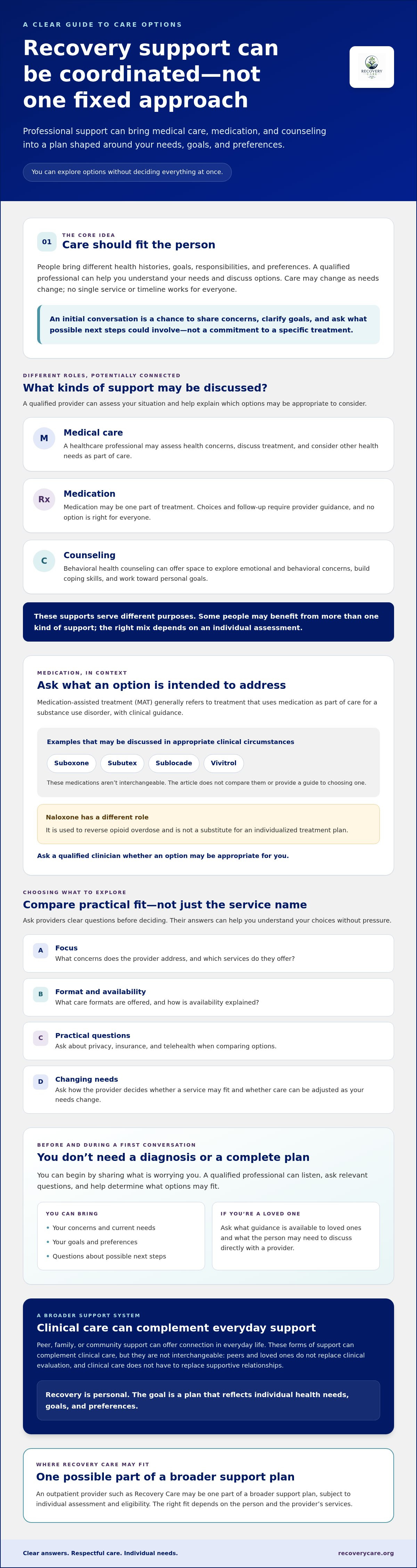
- Professional recovery support can include coordinated care shaped around your health needs and goals, rather than one fixed treatment approach.
- Medication, counseling, and medical care serve different purposes. A qualified provider can discuss whether they may fit your needs.
- Compare care options by their focus, format, availability, and practical fit. Ask providers specific questions before deciding.
- A first conversation is a chance to share your concerns, clarify your goals, and ask what possible next steps could involve.
- An outpatient provider such as Recovery Care may be one part of a broader support plan, subject to individual assessment and eligibility.
What Does Professional Recovery Support Mean?
Asking for help can feel like a big step, especially if you’re unsure what care involves or worry about being judged. Professional recovery support means individualized assistance from qualified healthcare and behavioral health professionals. They can help you understand your needs and discuss appropriate care options with you.
Clinical care is one part of a broader support system. A healthcare professional may assess health concerns and discuss treatment, while peer, family, or community support can offer connection in everyday life. These forms of support can complement one another, but they aren’t interchangeable. Peers and loved ones don’t replace clinical evaluation, and clinical care doesn’t have to replace supportive relationships. For background on the condition and its range of treatment approaches, see this overview of Substance use disorder.
Recovery is personal. People have different health histories, goals, responsibilities, and preferences, so no single service or timeline works for everyone. Care may change as needs change. You can explore options without deciding everything at once.
What can professional recovery support include?
Depending on your situation and a provider’s services, support may include an initial assessment, ongoing clinical care, counseling, or help addressing other health needs. A provider can ask about your health history, current concerns, and goals, then explain which options may be appropriate to discuss. For those seeking dedicated therapy to navigate personal or relationship challenges, you can learn more about Mindbender Counseling. Medication, a particular type of counseling, or a specific care setting isn’t right for everyone. Those decisions should be guided by an individual assessment and qualified professionals.
When comparing providers, ask what concerns they address, which services they offer, and how they decide whether a service may fit your needs. You can also ask whether care can be adjusted as your needs change. Clear answers help you understand your choices without pressure.
Who may consider reaching out for support?
You might consider a conversation if you’re concerned about your substance use, want help continuing care, or are a loved one seeking guidance on how to support someone. You don’t need to arrive with a diagnosis or a complete plan. Sharing what’s worrying you is enough to begin exploring possible next steps.
A first inquiry is a conversation, not a commitment to a specific treatment. A qualified professional can listen, ask relevant questions, and help determine what options may fit. If you’re reaching out for someone else, ask what guidance is available to loved ones and what the person may need to discuss directly with a provider.
How Do Medical Care, Medication, and Counseling Work Together?
Care doesn’t have to be a fixed package. A qualified team can consider medical care, medication, counseling, and other health needs, then discuss what may fit your situation. Some people may benefit from more than one kind of support. Others may begin with a particular concern and revisit their needs over time. The right mix depends on an individual assessment, not a one-size-fits-all rule.
SAMHSA describes recovery as a process that can involve health, home, purpose, and community. Its Recovery and Recovery Support resource offers more context on those dimensions. Clinical and behavioral support can address different needs while working toward goals a person identifies with their care team.
An individualized recovery plan may bring together medical guidance and behavioral support in ways that reflect a person’s health needs, goals, and preferences.
What role can medication-assisted treatment play?
Medication-assisted treatment, also called MAT, generally refers to treatment that uses medication as part of care for a substance use disorder, with clinical guidance. A provider considers your health history, current needs, and treatment goals. Medication choices and follow-up require ongoing provider guidance. No option is right for everyone.
Suboxone, Subutex, Sublocade, and Vivitrol are examples of medications that may be discussed in appropriate clinical circumstances. They aren’t interchangeable, and this overview isn’t a comparison or a guide to choosing one. Naloxone has a different role: it’s used to reverse opioid overdose and isn’t a substitute for an individualized treatment plan. Ask a qualified clinician what an option is intended to address and whether it may be appropriate for you.
How can counseling and primary care support recovery?
Behavioral health counseling can provide space to explore emotional and behavioral concerns, build coping skills, and work toward personal goals. Depending on your needs and the provider’s services, counseling may be considered alongside medical care. For more on counseling in the context of opioid use, read this guide to opioid addiction counseling.
Primary care gives you an opportunity to discuss general health concerns with qualified professionals, which may help inform a broader view of your care. If you’re exploring outpatient options, review Recovery Care’s available services and ask whether they match your needs and eligibility. Recovery Care offers medication treatment, behavioral health counseling, and primary care. Available services and appropriate treatment depend on individual clinical assessment.
How Can You Tell Which Recovery Support Options Fit Your Needs?
Choosing care is a personal decision, not a test with one correct answer. Asking about options doesn’t mean giving up your say. You can explain what matters to you, ask questions, and discuss possible next steps with a clinician before deciding whether to pursue a service.
Consider your health needs and personal goals alongside practical details, such as how you’ll access care and which format feels manageable. Outpatient visits, telehealth consultations, counseling, and medication services have different purposes. Availability, eligibility, and clinical fit vary, so confirm them directly with each provider.
| Care format or service | Potential focus | Questions to ask |
|---|---|---|
| Outpatient clinical care | Assessment and ongoing care while living in the community | What concerns can the provider assess, and what follow-up may be recommended? |
| Telehealth | Consultations by phone or video, when offered and appropriate | Am I eligible, and what technology or in-person options may be needed? |
| Behavioral health counseling | Emotional and behavioral needs, coping skills, and personal goals | What counseling services are available, and how are goals reviewed? |
| Medication services | Clinical discussion of medication options when appropriate | How does the clinician assess whether medication may fit, and what follow-up is involved? |
What should you ask a potential provider?
Use the first conversation to understand the services offered and how care decisions are made. You might ask:
- Which services are available, and how do clinicians assess individual needs?
- If relevant, how are medication decisions and follow-up handled?
- Is counseling available, and how might it relate to clinical care?
- What are the provider’s privacy practices, scheduling options, and approach to communication with other care providers?
These questions help you understand your choices and make your preferences part of the discussion.
How can insurance and access affect your options?
Coverage can vary by plan, service, provider, and individual circumstances. Before beginning care, contact your insurer and the provider to confirm benefits, provider participation, and any out-of-pocket responsibilities. Coverage for one service doesn’t necessarily mean another service is covered.
For more specific questions, explore these guides to Medicare coverage for Suboxone and Medicaid-accepting Suboxone clinics. A thoughtful conversation can help you evaluate professional recovery support while keeping your needs and choices at the center.
What Happens When You Reach Out for Professional Recovery Support?
Making the first contact doesn’t require a complete plan. You can start with a question, explain what’s concerning you, and learn what a provider may be able to discuss. A first conversation is an opportunity to gather information and consider possible next steps, not a promise of a particular treatment or timeline.
The process often follows a few manageable steps:
- Identify what you want to ask. You might be unsure which service fits, want to understand medication options, or need to know whether counseling is available.
- Contact a provider. Ask which services are offered and how to begin a conversation about your needs.
- Discuss your situation. A provider may ask about your health history, current concerns, medications, and goals.
- Clarify possible next steps. Ask what options may be appropriate, what follow-up could involve, and what information the provider needs from you.
How can you prepare for a first conversation?
If it feels comfortable, jot down your main concerns, health conditions, current medications, and questions. Share relevant information honestly so a clinician can better understand your needs. You don’t have to know in advance which details matter. The provider can explain what information is useful and why, and you can ask for clarification at any point.
You can also mention preferences that may affect access, such as whether you’re asking about in-person or telehealth care. Eligibility and availability can vary, so ask the provider to confirm what may be an option for you.
When is urgent or crisis support needed?
Routine outpatient care isn’t designed to respond to an immediate medical emergency. If you or someone else is in immediate danger, contact local emergency services. For mental health crisis support in the United States, call or text 988 to reach the 988 Suicide & Crisis Lifeline.
The SAMHSA National Helpline is a treatment-referral resource for people seeking help with substance use. Check SAMHSA’s official website for current contact details and information before reaching out.
Taking one step can be enough for now. If you’re exploring outpatient care, you can review Recovery Care services, including addiction treatment, behavioral health counseling, primary care, and telehealth consultations. Available services and eligibility should be confirmed directly, and appropriate care depends on an individual clinical assessment.
How Can Recovery Care Be One Part of Your Support Plan?
Professional recovery support can take different forms. One provider may be a useful part of a wider plan rather than the only source of care. Recovery Care is an outpatient provider offering addiction treatment, behavioral health counseling, and primary care. Its clinicians can discuss available services based on your needs and an individual clinical assessment.
In-person care and telehealth consultations are offered, but eligibility and service availability depend on individual circumstances. Confirm directly whether a service is available to you and whether it fits your clinical needs. A conversation can help you understand the options without assuming that every service or medication will be appropriate.
Which services may be available through Recovery Care?
Depending on clinical assessment and eligibility, services may include outpatient treatment involving medications such as Suboxone, Subutex, Sublocade, Vivitrol, or Naloxone when appropriate. These medications have different roles. A clinician can explain which options, if any, may be relevant to your situation.
Recovery Care also offers behavioral health counseling, primary care, diagnostic services, and telehealth consultations. Availability can vary, so ask which services are currently offered and how they may relate to your care needs. For medication-specific background, read this Suboxone treatment guide.
What should you confirm before scheduling?
Before making plans, ask about the details that matter to your circumstances:
- Which services are available, and what eligibility requirements apply?
- Are in-person or telehealth appointments an option for you?
- What appointment options are currently available?
- Does the provider participate in your insurance plan, and what costs may be your responsibility?
Recovery Care accepts most major insurance plans, Medicare, and Medicaid, but participation and coverage can vary. Verify your benefits with both the insurer and provider rather than assuming a particular service will be covered. A clear answer about access can help you decide whether to continue exploring care.
If you’d like to learn more, Explore Recovery Care and ask about available support. It’s a low-pressure way to find out what services may be available and whether they could fit your needs.
Take One Thoughtful Step Toward Care
Professional recovery support isn’t a single treatment or a fixed timeline. The right care depends on your needs, goals, and clinical assessment. Asking questions can help you understand your options and stay involved in decisions about your care.
Recovery Care offers outpatient addiction treatment, behavioral health counseling, and primary care. Care is led by Medical Director Dr. Heather Rosen, MD, with in-person and telehealth options subject to eligibility and availability. Ask which services may fit your situation and confirm practical details, including insurance participation, before making plans.
If you’re ready to learn more, Explore Recovery Care and ask about available support. You don’t have to figure out every next step today. A conversation can be a manageable beginning, and you deserve to approach it at your own pace.
Frequently Asked Questions
What is professional recovery support?
Professional recovery support is individualized care from qualified healthcare and behavioral health professionals to help address substance use and related health needs. Depending on a person’s circumstances and a provider’s services, it may involve clinical evaluation, counseling, medication discussions, or other services. You can ask questions before deciding whether to pursue care. Seeking information helps you understand your options without committing to a specific treatment.
What types of professional support are available for addiction recovery?
Options may include outpatient addiction treatment, medication services, behavioral health counseling, primary care, and peer or community support. These options serve different purposes and aren’t available from every provider. Recovery Care offers outpatient addiction treatment, counseling, primary care, diagnostic services, and telehealth consultations. Ask providers which services they offer, who may be eligible, and whether those services match the support you’re looking for.
Can recovery support include medication and counseling?
Yes. Depending on an individual clinical assessment, a care plan may include medication, counseling, both, or other forms of support. Medication choices require guidance from a qualified clinician, who can explain possible options and appropriate follow-up. Counseling may offer space to work on emotional or behavioral health needs and personal goals. If you are seeking broader therapy support, you can explore Individual Counselling to help navigate personal challenges. These services aren’t a fixed package, and no particular approach is right for everyone.
How do I know what kind of recovery support is right for me?
A qualified professional can help you explore options based on your health history, current concerns, goals, and preferences. Consider practical factors too, such as appointment format, access, and insurance participation. Ask how the provider assesses needs and what follow-up may involve. Take time to understand the answers and share your preferences. The first conversation can clarify possibilities without requiring an immediate decision.
Does insurance cover professional recovery support?
Coverage depends on your insurance plan, the specific service, the provider, and your individual circumstances. Recovery Care accepts most major insurance plans, Medicare, and Medicaid, but participation doesn’t guarantee that a particular service will be covered. Contact your insurer and the provider to confirm benefits, provider participation, and any out-of-pocket responsibility before beginning care. Ask about each service separately, since coverage may differ across types of care.
Can I get professional recovery support through telehealth?
Some providers offer telehealth consultations, but whether this format is available and appropriate can depend on your location, eligibility, clinical needs, and the provider’s current services. Recovery Care offers telehealth consultations, subject to eligibility and availability. Ask whether you can receive the service where you live, what concerns can be addressed remotely, and whether any in-person care may also be needed.
What should I do if I need immediate help instead of outpatient support?
Outpatient care isn’t a substitute for emergency help. If you or someone else is in immediate danger or facing a medical emergency, contact local emergency services. For mental health crisis support in the United States, call or text 988. If you’re seeking substance use treatment referrals, SAMHSA’s National Helpline can help connect you with resources. Confirm current contact details through SAMHSA’s official website.


