

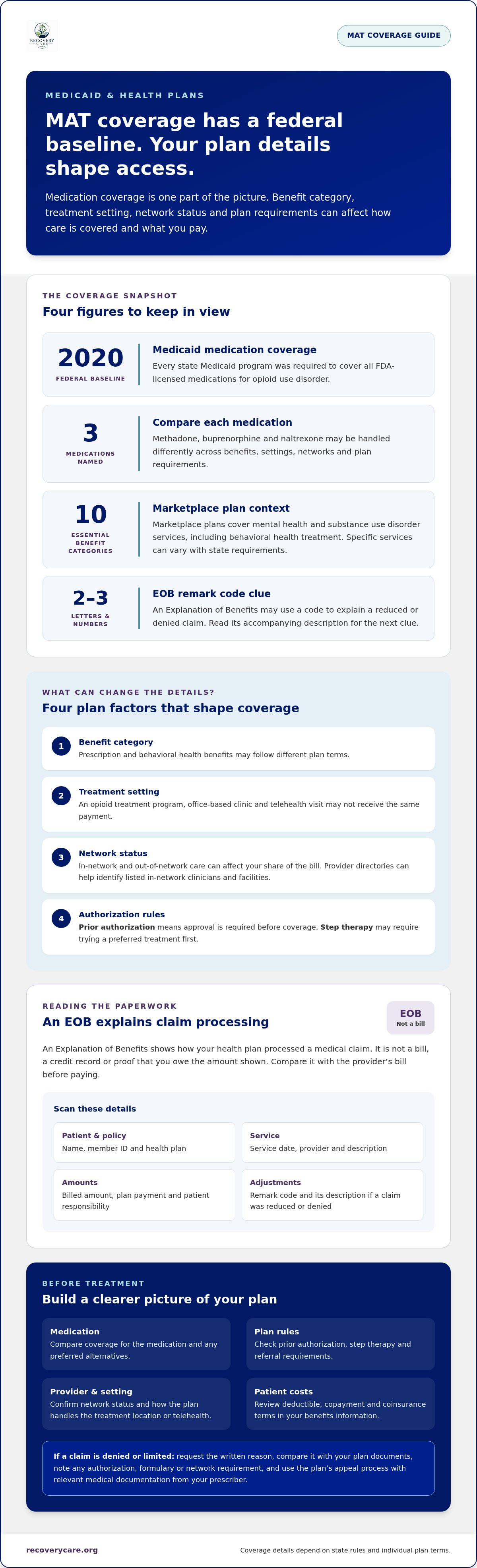
No, Medicaid MAT benefits aren’t identical in every state. In 2020, every state Medicaid program was required to cover all FDA-licensed medications for opioid use disorder, but state rules and individual plan details can affect which services are covered and what you pay. Understanding your insurance benefits for MAT means looking beyond whether treatment is covered to the details that shape your costs and access.
It’s understandable to want clear answers before starting care. Coverage can feel complicated when medication benefits, provider networks, referrals, deductibles, copayments, and coinsurance all play a part. This guide to understanding your insurance benefits for MAT explains how state Medicaid rules and health plan terms influence coverage, what to look for in your benefits information, and how out-of-pocket costs may apply. A clearer picture of your plan can help you make informed decisions about treatment.
Key Takeaways
- Medicaid coverage rules vary by state, while plan requirements can shape which MAT services and medications are covered.
- Use your Explanation of Benefits to understand how your plan processed a claim, what it paid, and what balance may remain.
- Review your deductible and copay terms to see when you pay a set amount and when costs may apply before coverage contributes.
- Network status can affect your share of the bill, so understand how your plan treats in-network and out-of-network care.
- Coinsurance is a percentage of an allowed cost; knowing your share can help you anticipate expenses after your deductible applies.
Medicaid coverage of FDA-approved OUD medications
Medicaid coverage for opioid use disorder medications has a federal baseline, but state rules and plan terms still affect treatment details. The medication, benefit category, network, and authorization requirements can all shape what happens at the pharmacy or clinic.
Medication Coverage Across Health Plans
Medicaid, Medicare, and private insurance use different coverage rules for FDA-approved medications for opioid use disorder. In 2020, the Centers for Medicare & Medicaid Services announced that every state Medicaid program must cover all FDA-licensed medications for opioid use disorder. This gives Medicaid members a medication-coverage baseline, while plan requirements can still affect access and patient payments.
Coverage for MAT may depend on the benefit involved and treatment setting. Part A doesn’t cover MAT needed after discharge. Private plans vary by plan design, and Marketplace plans cover mental health and substance use disorder services, including behavioral health treatment.
Methadone, buprenorphine, and naltrexone aren’t necessarily handled identically by every health plan. Coverage can differ by medication benefit, treatment setting, network status, and plan requirements. Compare each medication’s coverage and any authorization rules.
Coverage Rules and Patient Protections
Coverage rules describe which treatment a plan covers and which conditions apply before payment. Marketplace health plans cover 10 essential health benefit categories, according to HealthCare.gov, including mental health and substance use disorder services. The services included within broad categories can vary with state requirements, so two plans may apply different details.
Prior authorization means a plan requires approval before covering a service or medication. Step therapy means the plan may require you to try a preferred treatment before covering another option. These rules vary by plan. Ask whether either applies to methadone, buprenorphine, or naltrexone, and whether the prescriber must submit supporting medical information.
Federal protections include the Affordable Care Act’s essential health benefit requirements for compliant plans. State requirements can shape which services fall within those benefit categories. Ask your insurer which state rules and plan terms apply to your individual coverage, including behavioral health and prescription benefits.
Responding to Coverage Limits or Denials
A denial or limit explains how the insurer processed a claim, but doesn’t necessarily determine whether treatment can proceed. Request the written reason, identify the medication or service involved, and compare the explanation with your plan documents. Note any authorization, formulary, or network requirements.
Then use the plan’s appeal process and provide relevant medical documentation from your prescriber. Ask what information the insurer needs and how it reviews appeals. Before starting treatment, ask about covered medications, preferred alternatives, prior authorization, step therapy, referral requirements, network status, and patient payments.
Auto coverage is separate from health insurance for MAT. Uninsured motorist coverage can reimburse a driver after an accident caused by an uninsured motorist; underinsured motorist coverage can help when the other driver lacks enough insurance. Personal auto policies generally cover personal driving, not commercial uses such as pizza delivery. These benefits concern vehicle accidents, not OUD medication treatment.
Patient and health plan information on an EOB
An Explanation of Benefits (EOB) shows how your health plan processed a medical claim. It is not a bill, a credit record, or proof that you owe the amount shown. For example, an EOB may list the service, the insurance company’s payment, and any amount assigned to you. Compare it with the bill from the provider before paying, since the documents serve different purposes.
Start with the patient and policy details. Confirm your name, member identification, health plan, and service date. Then review the provider, service description, billed amount, plan payment, and patient responsibility. If an EOB covers a behavioral health visit, check that the listed service matches the appointment. An error in a date or patient detail can make a claim difficult to interpret.
Look for an adjustment or remark code when a claim was reduced or denied. An EOB remark code is usually 2 or 3 letters and numbers. The code helps explain how the insurance company handled the claim; its accompanying description provides the next clue. For instance, a message may point to missing information or a plan rule. Keep the EOB and bill together so you can compare the explanation with the amount requested.
The Affordable Care Act, passed in 2010, made medication-assisted treatment an essential health benefit for compliant health plans. Marketplace health insurance plans cover 10 essential health benefit categories, according to HealthCare.gov. These include mental health and substance use disorder services, but the specific services within broad categories can vary with state requirements. Marketplace plans also cover behavioral health treatment, so a plan’s benefit documents can clarify how a particular service is handled.
Coverage at an opioid treatment program, office-based clinic, or through telehealth depends on the plan’s covered services, network rules, and billing. A listed benefit alone doesn’t mean every location or visit format receives the same payment. For example, an in-network office visit and a virtual appointment may follow different plan terms. Review the provider directory and telehealth benefit details for your plan.
Provider directories can help identify clinicians and facilities listed as in-network. Search by the provider’s name and specialty, then compare the result with your plan’s network and the EOB after a visit. For care through telehealth consultations, review the plan’s virtual-care terms alongside the provider listing. An EOB for a medical claim is separate from an auto accident claim, and it doesn’t function as a credit report.
Deductibles, copayments, and other out-of-pocket costs
Your plan’s deductible, copayment, and coinsurance determine how costs are shared for covered care. A Marketplace plan may apply these expenses to MAT visits or prescriptions, depending on its benefit terms.
Deductibles and Copayments
A deductible is the amount you pay for covered services before your plan starts paying under the deductible rules. A copayment is a fixed amount you pay for a covered service, such as a visit. These costs matter because two plans can cover the same treatment but leave you with different payment responsibilities.
That example doesn’t mean every MAT service is covered at 100% afterward. Your plan may apply separate terms to prescriptions, appointments, or behavioral health treatment.
Those examples show how a set copayment works, not the amount you’ll pay for MAT. A plan may use different copays for a primary care visit, hospital service, or prescription. Read the benefit description for each service category rather than assuming one copay applies throughout treatment.
To interpret your plan, identify the deductible, copay, and any coinsurance listed for each relevant benefit. Then note whether the deductible applies before the copay or is waived for certain services. An Explanation of Benefits can show how the insurer processed a claim, while the plan document explains the cost-sharing rules behind that payment.
Premiums and Copays
A premium is the recurring payment for keeping health insurance active; a copay is tied to a covered service. Both affect your budget, but they work differently. An employer often pays part of an employer-sponsored plan’s premium, while the employee may contribute the remainder. Your premium alone doesn’t show what an MAT visit or prescription will cost.
Compare premiums alongside deductibles, copays, and coinsurance when reviewing insurance plans. A lower premium can come with different out-of-pocket terms, so consider how the plan treats recurring appointments and medication benefits. For example, check whether prescription coverage has a separate deductible or copay from medical visits. Government and Marketplace plan materials describe plan benefits, while an employer’s summary can explain its group plan.
Keep medical and dental benefits distinct: a dental copay doesn’t automatically apply to MAT. For each treatment category, record the premium, deductible, copay, and coinsurance in separate columns. This simple comparison helps you see which costs recur each month and which arise only when you receive a covered service.
Provider networks and out-of-network costs
A provider network is a group of clinicians and facilities contracted with a health insurance plan. The plan’s directory identifies providers it considers in-network; clinicians outside that group are out-of-network. For someone seeking MAT, network status can affect how the plan calculates its payment and the patient’s share. A covered service can still have different cost-sharing depending on where care is received.
Start with the exact plan name on your insurance card, then search its provider directory for the clinician or facility. Confirm that the provider’s name, location, and specialty match the listing. For example, a clinic may appear in one network offered by an insurance company but not another. A Marketplace insurer can offer several plans with distinct directories, even under the same company name.
Network status can apply separately to the clinician, facility, and service. A provider may be in-network while a particular service follows different plan terms. Before an appointment, identify the billing provider and setting, such as an office visit or telehealth appointment. Ask which network applies to that plan and service. Record the answer and date, then compare it with the Explanation of Benefits after the claim is processed.
Out-of-network care may be paid under different benefits or may not receive the same plan contribution as in-network care. Your plan documents explain whether out-of-network benefits apply, which deductible governs, and how the insurer calculates its allowed amount. For example, a plan could process an in-network visit under its standard medical benefit but apply separate cost-sharing to an out-of-network visit. Don’t assume the directory listing alone determines your final payment.
Marketplace health insurance plans include essential health benefits across plan types, including HMOs and PPOs, but network access depends on the specific plan. An HMO or PPO label doesn’t identify every participating provider. Federal benefit requirements and the plan’s network are separate considerations: one describes covered benefit categories, while the other identifies contracted clinicians and facilities.
Keep a simple record for each MAT appointment: provider name, service location, network status, and the plan’s stated benefit. If a directory result conflicts with the insurer’s explanation, compare the provider details and claim information. A behavioral health counseling visit, for instance, may have its own network classification. These steps help you distinguish a coverage question from a network or billing issue without relying on a general directory search.
Deductibles and coinsurance
A deductible and coinsurance work together to determine your share of covered care. The deductible is what you pay first under your plan’s rules; coinsurance is a percentage of an allowed charge. For MAT, these terms can affect medical visits, prescriptions, and other covered services differently. Knowing which benefit applies helps you understand how the insurer calculated your portion.
Here’s how coinsurance works: in the example, an insurer pays 80% of a $100 x-ray, leaving the patient to pay $20. The percentage applies to the allowed cost, not necessarily the provider’s original charge. For a MAT service, your plan’s allowed amount and coinsurance percentage determine the patient share. Check both figures in the plan documents or Explanation of Benefits.
The deductible affects when coinsurance begins. If a covered service is subject to the deductible, you pay the allowed amount until you meet it. Afterward, coinsurance may apply to additional eligible care. A plan can also treat prescription benefits separately from office visits, so don’t assume payments for one service count toward another deductible.
Marketplace plans generally apply deductibles, copayments, and other out-of-pocket costs to most covered services. The Affordable Care Act’s essential health benefit rules define broad coverage categories, while plan terms explain cost-sharing. States can shape which services fall within those categories. As a result, two plans may cover substance use disorder treatment but set different deductibles or coinsurance.
To estimate your share, identify the service category first. Then find its deductible, coinsurance rate, and allowed-amount rules. Check whether the deductible has been met and whether the service is in-network. An out-of-network claim can follow different cost-sharing terms. Keep the plan’s benefit summary beside your EOB, then compare the insurer’s calculation with the amount assigned to you.
Coinsurance differs from a copayment: coinsurance is a percentage, while a copayment is a fixed payment for a covered service. Your premium is separate, too. It keeps the insurance plan active but doesn’t count as payment toward every service’s deductible. Reviewing these terms together can help you assess whether a plan’s costs fit your budget without assuming care will be affordable for everyone.
For MAT care options, explore treatment support as you consider how your plan’s cost-sharing applies.
Recovery Care: Suboxone Treatment
Recovery Care provides Suboxone Treatment for people seeking outpatient care for opioid use disorder. Once you understand your plan’s medication, network, and cost-sharing terms, you can consider how they apply to treatment options. Recovery Care accepts most insurances, including Medicare and Medicaid. Your plan’s benefits determine your coverage and payments.
Care options also include Sublocade Injections, Vivitrol Injections, and Telehealth Consultations. If you’re comparing coverage for medication or virtual appointments, your plan’s benefit details can help you understand how those services are processed. Bring your coverage questions as you explore care in a respectful, supportive setting.
Contact Recovery Care to discuss your next steps.
Take the Next Step Toward Care
Insurance details can help you plan, but they don’t need to be your only concern. A practical next step in understanding your insurance benefits for MAT is to connect the coverage information you’ve gathered with the treatment options you want to discuss. That can make your next conversation more focused and useful.
Recovery Care provides Suboxone Treatment, Sublocade Injections, and Vivitrol Injections. Bring questions about your plan as you consider which care option may fit your needs. You don’t need to understand every insurance term before reaching out. Start with what you know, such as your plan name or a coverage question, and take the conversation one step at a time.
Contact Recovery Care about MAT benefits to discuss your next step. Seeking support is a meaningful move forward, and you deserve to approach it with dignity and care.
Frequently Asked Questions
Are the benefits the same in each state?
No, Medicaid treatment benefits can differ by state, although medication coverage has a federal baseline. In 2020, every state Medicaid program was required to cover all FDA-licensed medications for opioid use disorder. States can still differ in plan administration and the services included within broad benefit categories. For example, a covered medication may have different authorization or delivery requirements under state Medicaid plans.
Do private insurance companies cover MAT?
Yes, private health plans can cover MAT, but the terms depend on the plan. Marketplace plans cover mental health and substance use disorder services, including behavioral health treatment. Employer-sponsored plans also vary: large employers that self-insure aren’t required to provide essential health benefits, and grandfathered plans aren’t required to cover those benefits. A plan’s prescription and behavioral health terms show how specific services are handled.
What’s an explanation of benefits?
An Explanation of Benefits, or EOB, is a document from your insurer showing how it processed a medical claim. For example, it may list a counseling visit, the amount the plan allowed, and the amount assigned to you. It isn’t a bill. Compare the EOB with the provider’s bill, and review any remark code or claim message to understand adjustments or denial reasons.
Who is covered, and when?
Coverage depends on the policy and the person enrolled in it. Under the Affordable Care Act, young adults can remain on a parent’s health plan until age 26. Medicare is for people age 65 or older, according to the Centers for Medicare & Medicaid Services, and CHIP provides health insurance for children. Individual plan enrollment or renewal can occur during annual Open Enrollment.
Why Do Health Plans Cover Medication-Assisted Treatment?
For compliant plans, coverage reflects federal essential health benefit requirements. The Affordable Care Act, passed in 2010, included mental health and substance use care, as well as prescription drugs, among essential health benefits. These categories make substance use disorder treatment part of covered health care for applicable plans. The precise services included within a category can vary with state requirements and the plan’s benefit design.
What does insurance typically cover for medication-assisted treatment (MAT) for opioid use disorder?
Coverage can include FDA-approved OUD medications and behavioral health treatment, depending on the health plan and benefit terms. Medicaid programs must cover all FDA-licensed medications for opioid use disorder. Marketplace plans cover substance use disorder services, but specific services and cost-sharing differ. Treatment setting, prescription rules, network status, and authorization requirements can affect how a medication or appointment is processed.
How can I check my insurance benefits for MAT and confirm a provider is in network?
Understanding your insurance benefits for MAT starts with matching your exact plan to its benefit documents and provider directory. Use the full plan name from your insurance card, then search the directory by provider and specialty. Confirm the listed clinician and location, and review separate terms for prescriptions, office visits, or telehealth. Your plan’s member services can explain directory entries and benefit language for a specific service.
What are the typical copays, deductibles, and out-of-pocket costs for MAT?
There isn’t one typical cost that applies across MAT plans. Your out-of-pocket amount depends on the service benefit, deductible, copayment or coinsurance, network status, and whether prescription coverage has separate terms. A copayment is a fixed amount; coinsurance is a percentage of an allowed charge. Compare these terms for medication and visits in your plan documents to understand how each type of care is cost-shared.


