
What if a provider says they accept Medicaid but does not take your specific plan or offer telehealth where you live? Finding telehealth suboxone doctors that accept medicaid involves more than checking a box on a website. Before taking the next step, it helps to know what to confirm about coverage, privacy, eligibility, and the first appointment.
This 2026 guide explains how to find providers to contact and verify whether your Medicaid plan may cover the care you’re considering. You’ll learn what to ask about telehealth in your state, Suboxone coverage, possible plan requirements, and follow-up care. Coverage and provider eligibility can vary, so confirm the details for your plan and location before scheduling.
Recovery Care offers outpatient Suboxone treatment and telehealth consultations. The care team can discuss plan details and next steps after an individual assessment. This guide also covers how to prepare for a first appointment, what information to have nearby, and how to ask questions in a private, supportive conversation. You can take it one step at a time, starting with confirming whether a provider can serve you.
Key Takeaways
- When searching for telehealth suboxone doctors that accept medicaid, verify your exact plan and whether the provider can see patients in your state.
- Check provider participation, telehealth visit coverage, and medication coverage separately; each may have different requirements.
- Ask about privacy, follow-up care, and any plan requirements before scheduling so you know what to expect.
- Make your first appointment easier by having your Medicaid card, medication list, pharmacy details, and relevant health history nearby.
- Recovery Care accepts Medicaid and offers telehealth consultations and outpatient Suboxone treatment; confirm your specific plan and services with the care team.
How to find telehealth Suboxone doctors that accept Medicaid
When you’re sorting through Medicaid coverage questions, start by defining what you’re looking for: a clinician who can meet with you remotely, evaluate opioid use disorder, and determine whether Suboxone treatment may be appropriate. Searching for telehealth suboxone doctors that accept medicaid is a starting point, not the final check. You also need to confirm that the provider can see patients where you live and participates in your specific plan.
“Accepts Medicaid” does not necessarily mean the provider takes every state plan or managed care network, or that every appointment and prescribed medication is covered. Provider availability and telehealth eligibility can depend on your location and individual circumstances. Contact the provider and your plan to clarify requirements before scheduling.
What “accepts Medicaid” should mean for your search
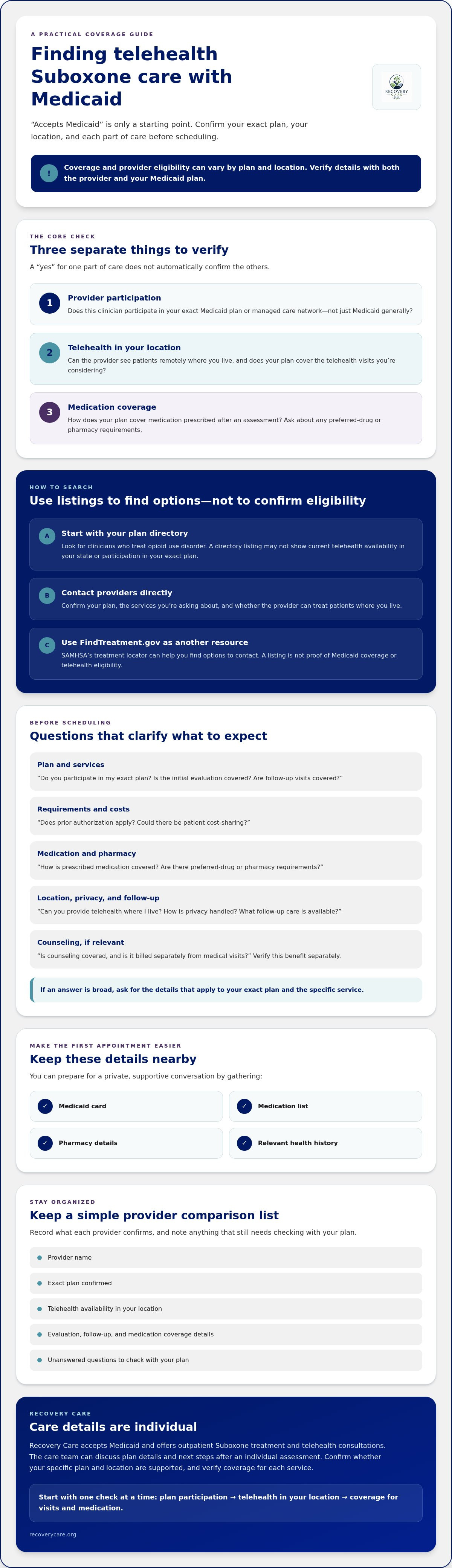
A provider may accept Medicaid generally but not participate in your particular plan or network. Confirm each part of care separately: the initial evaluation, follow-up visits, and prescribed medication. Ask whether plan requirements such as prior authorization apply, and whether you may have cost-sharing. Coverage decisions depend on your plan and the service, so ask for answers that refer to your exact plan rather than Medicaid in general.
Medicaid acceptance must be confirmed for the specific plan and service.
Where to start looking for telehealth care
Start with your Medicaid plan’s provider directory and look for clinicians who treat opioid use disorder. Then contact the providers directly. Directories may not show whether a clinician currently offers telehealth to patients in your state or participates in your exact plan. Before booking, ask both questions and confirm that the provider can discuss the services you’re seeking.
SAMHSA’s FindTreatment.gov is another general resource for locating treatment options. Use a listing to build a contact list, not as proof of Medicaid coverage or telehealth eligibility. When you call, ask the provider to verify your plan, the services you’re considering, and whether they can treat patients in your location.
As you compare options, it may help to understand the medication being discussed. Suboxone contains buprenorphine, and the Buprenorphine overview provides background on this active medication. For more context on treatment, see Suboxone Treatment: A Comprehensive Guide to Opioid Recovery in 2026.
Keep a short comparison list with the provider’s name, the exact plan they confirmed, telehealth availability, and what they said about evaluation, follow-up, and medication coverage. Note any unanswered questions so you can check them with your plan. Recovery Care offers outpatient Suboxone treatment and telehealth consultations, and accepts Medicaid. Contact the team to discuss your specific plan and whether telehealth may be available for your location. Confirming one item at a time can make the search more manageable.
What Medicaid may cover for telehealth Suboxone treatment
Medicaid does not provide one identical set of benefits nationwide. State Medicaid programs and managed care plans can have different provider networks, telehealth rules, and coverage details. A provider’s general statement that they accept Medicaid is a useful starting point, but it does not confirm that your specific plan covers each part of care.
Break the coverage check into three questions: Does the clinician participate in your plan? Does your plan cover the telehealth visits you’re considering? How does it cover medication prescribed after an assessment? Confirm these details with both the plan and provider before care begins. Ask whether prior authorization, a particular pharmacy, or patient cost-sharing may apply.
Which parts of care should you ask about?
Ask about the specific services you may receive. Check whether your plan covers the initial clinical evaluation and follow-up visits, and whether the provider is in network for your exact plan. Medication benefits may follow different rules from visit benefits, including preferred-drug or pharmacy requirements. If the provider or plan gives a broad answer, ask them to clarify the benefit for the service you’re asking about.
If counseling is part of the care you’re considering, ask whether it’s covered and billed separately from medical visits. Recovery Care offers behavioral health counseling, but your plan’s coverage for that service should be verified separately.
- Is the initial evaluation covered under my plan?
- Are follow-up telehealth visits covered, and are there any requirements?
- How is the prescribed medication covered, and must I use a preferred pharmacy?
- Could prior authorization or patient cost-sharing apply?
- Is counseling billed separately from medical visits?
Why coverage depends on your plan and location
State Medicaid programs and managed care plans may use different provider networks and coverage rules. Telehealth eligibility also depends on whether the provider can see patients in your state. Before booking, confirm your location is within the provider’s current telehealth eligibility and ask your plan whether the service is covered in that setting.
For help identifying practitioners, the SAMHSA Buprenorphine Practitioner Locator can be a starting point. A listing does not confirm plan participation or benefits, so contact the provider and your Medicaid plan to verify both.
Recovery Care accepts Medicaid and offers telehealth consultations and outpatient Suboxone treatment. Your specific plan, services, and telehealth eligibility still need to be confirmed. You can contact Recovery Care about plan verification and ask which details to check before scheduling.
Questions to ask before choosing a Medicaid-accepting telehealth doctor
A clear checklist can help you compare telehealth suboxone doctors that accept medicaid without feeling pressured to have every answer upfront. Asking for clarification is a practical part of checking whether care fits your plan and needs. A general “we accept Medicaid” statement is not the same as verified participation in your specific plan.
How to verify a provider and your Medicaid plan
Ask the provider for the exact billing name and whether that billing entity participates in your specific Medicaid plan. Then call the member services number on your insurance card to confirm provider participation and ask about the relevant telehealth benefit. Be specific about the services you’re asking about, such as an initial evaluation or follow-up visit. If available, write down the representative’s name, the call date, and a reference number so you have details for a follow-up.
Plan rules and reimbursement can vary. Research on telehealth OUD treatment from The Pew Charitable Trusts discusses how state policy can shape access, including Medicaid reimbursement. For your own coverage, confirm the details directly with your plan and provider.
| Question | Why it matters | What answer to confirm |
|---|---|---|
| Do you participate in my exact Medicaid plan? What billing name should I give my plan? | A clinic may accept Medicaid generally without participating in every plan or network. | Confirm the provider’s billing name and participation with both the provider and plan. |
| Can you provide telehealth care to someone located in my state? | Provider eligibility and telehealth availability depend on where you’ll be during the visit. | Confirm your location is eligible before booking. |
| How are the evaluation, follow-up visits, and prescribed medication covered? | Visit and pharmacy benefits may have different coverage rules. | Ask about authorization requirements, preferred pharmacies, and any cost-sharing. |
| How is my health information protected during virtual visits? | You deserve to understand how your information is handled and how to attend privately. | Ask how the visit is conducted, what platform is used, and whom to contact with privacy questions. |
| Who conducts the evaluation, and how is follow-up arranged? | Knowing who you’ll meet with and how ongoing care works helps you choose a process that feels supportive. | Confirm who evaluates you, how follow-up is scheduled, and whom to contact with questions. |
Compare care, privacy, and follow-up
Take notes as you speak with providers, especially about what is confirmed and what still needs checking. If an answer is unclear, ask for a plain-language explanation or for the right person to contact. You can also learn more about what virtual support may involve in Telehealth Addiction Counseling: A Comprehensive Guide to Virtual Recovery. Before choosing, make sure you understand plan details, location eligibility, privacy practices, and how follow-up is arranged well enough to feel comfortable with the next step.
How to prepare for your first telehealth Suboxone appointment
Your first virtual appointment isn’t a test you have to pass. A little preparation can make it easier to discuss your questions, but you don’t need to have everything perfectly organized. The clinician will use an individual assessment to understand your health and discuss whether Suboxone or another next step may be appropriate.
What information should you have ready?
If you can, gather a few details before the visit. Having them nearby can save time and help the provider understand your situation. If you don’t have every item, let the care team know and ask what else may be needed.
- Your Medicaid card and member details, plus the name of your plan.
- A current medication list, including doses if known, and any allergies.
- Your preferred pharmacy’s name, address, and phone number.
- Relevant health history, such as current concerns, past treatment, and other conditions you’d like the clinician to know about.
- Questions about medication options, follow-up, counseling, pharmacy coverage, and next steps.
Don’t stop, start, or change medication based on general information or in preparation for the visit. Discuss medication questions with a qualified clinician who knows your health history.
What happens during a virtual evaluation?
The clinician may ask about your health history, current concerns, and treatment goals. Share what feels relevant and ask for clarification at any point. The provider will assess your individual needs and discuss clinically appropriate options; a prescription or particular treatment plan isn’t guaranteed.
Depending on the assessment, the provider may explain how follow-up works and whether additional support, such as counseling, could be considered. Before the appointment, confirm whether it will be by video or another format, what device or technology you’ll need, and whether there are forms to complete. Ask how to join the visit and what to do if you have trouble connecting.
Choose a private space if possible, and ask the provider how health information is protected during virtual visits. If you’re looking for telehealth suboxone doctors that accept medicaid, have your plan details nearby and raise any remaining coverage questions before care begins. To learn more about the early treatment experience, see What to Expect During Your First Week of Suboxone Treatment.
Recovery Care offers telehealth consultations and outpatient Suboxone treatment. To discuss what to have ready and ask about your specific plan and location, contact Recovery Care about a telehealth consultation.
Take the next step with Recovery Care telehealth
Seeking help can begin with a conversation, not a commitment. Recovery Care offers outpatient Suboxone treatment and telehealth consultations in a compassionate, individualized care setting. The clinic accepts Medicaid, but that does not automatically confirm that your specific plan covers a particular visit or medication. Telehealth availability also depends on your location and provider eligibility.
If you’re considering telehealth suboxone doctors that accept medicaid, contact the care team to ask whether Recovery Care may be an option for you. You can ask for clarification, take notes, or gather information before deciding what to do next.
What to confirm before scheduling
Before arranging an evaluation, ask whether the clinic can provide telehealth care to patients in your state. Then verify your exact Medicaid plan and ask about coverage for the visit types you’re considering, prescribed medication, and any potential patient responsibility. The plan and clinic may be able to clarify different parts of your coverage, so confirm details with both.
You can also ask what information the team needs to check eligibility and discuss an appropriate evaluation. Having your Medicaid card and plan details nearby may help. If you’re unsure what to ask, start with one question: “Can you help me confirm whether my plan and location are eligible for this service?”
How ongoing support can fit into treatment
Suboxone treatment is one option a clinician may discuss after an individual assessment. Recovery Care also offers behavioral health counseling, and the care team can talk with you about available treatment options and next steps. Ongoing care is shaped around your needs and discussed with the clinical team; it isn’t a one-size-fits-all plan or a promise of a particular outcome.
You don’t have to resolve every detail on your own before reaching out. Contact the Recovery Care team to discuss telehealth and Suboxone treatment, confirm whether care may be available where you live, and ask about your Medicaid plan. A conversation can be a low-pressure first step.
If you or someone else is in immediate danger, call your local emergency number or go to the nearest emergency department.
Take a clear, supported next step
Finding telehealth Suboxone doctors that accept Medicaid starts with verifying the details that matter to you: whether the provider participates in your exact plan, whether telehealth is available where you live, and how visits and medication may be covered. Asking about privacy, follow-up, and what to expect at an evaluation can help you feel more prepared.
Recovery Care accepts Medicaid and offers outpatient Suboxone treatment and telehealth consultations. Confirm your specific plan, covered services, and location eligibility before scheduling. Care is led by Medical Director Dr. Heather Rosen, MD, and the team can discuss treatment options and next steps after an individual assessment.
If you’re ready to ask questions, contact Recovery Care to discuss telehealth and verify your Medicaid plan. You don’t need to have everything figured out before reaching out. A thoughtful conversation can be a manageable first step toward care that respects your needs.
Frequently Asked Questions
Can I get Suboxone through telehealth with Medicaid?
Possibly, if a clinician determines Suboxone may be appropriate and your provider, plan, and location meet the relevant requirements. Medicaid acceptance alone doesn’t confirm that your specific plan covers the evaluation, virtual visits, or medication. Before scheduling, ask the provider whether they can offer telehealth where you live, then verify plan participation and benefits with your Medicaid plan.
How do I find telehealth Suboxone doctors that accept my Medicaid plan?
Start with your Medicaid plan’s provider directory, then contact potential clinics to confirm they participate in your exact plan and can provide telehealth where you live. Search tools can help identify providers, but a directory listing isn’t a coverage confirmation. Ask about the initial evaluation, follow-up visits, medication coverage, and any plan requirements before booking. Recovery Care accepts Medicaid, but specific plans and services should be verified.
Does Medicaid cover online Suboxone appointments?
It depends on your state program and specific Medicaid plan. Coverage for a telehealth evaluation or follow-up visit may have different conditions from coverage for an in-person appointment. Ask your plan whether the relevant telehealth service is covered and whether authorization or other requirements apply. Also confirm that the provider can serve patients in your location and participates in your plan’s network.
Will Medicaid cover the Suboxone medication as well as telehealth visits?
Medication coverage and telehealth visit coverage are separate benefits, so confirm each one. Ask your Medicaid plan how the prescribed medication is covered, whether a preferred pharmacy is required, and whether prior authorization or patient cost-sharing may apply. The clinician determines appropriate treatment after an assessment, and coverage can depend on your specific plan and prescription. Verify details with both the plan and provider.
Can I use a telehealth Suboxone provider if I live in another state?
Not automatically. A provider’s ability to see you by telehealth depends on your location and the provider’s eligibility to serve patients there. Your Medicaid plan may also have its own network and coverage requirements. Before scheduling, tell the clinic which state you’ll be in during the appointment and ask whether telehealth is available to you. Then confirm plan participation and coverage directly with your Medicaid plan.
What should I ask a telehealth Suboxone doctor before scheduling?
Ask whether the provider participates in your exact Medicaid plan and can see patients in your state. Confirm coverage separately for the evaluation, follow-up visits, and medication, including any authorization, pharmacy, or cost-sharing requirements. You can also ask who conducts the evaluation, how follow-up works, how your health information is protected, and whom to contact with questions. It’s reasonable to ask for clear explanations.
What happens during a first telehealth Suboxone appointment?
The clinician will generally discuss your health history, current concerns, and treatment goals, then assess what options may be appropriate for you. You can ask questions and share what matters to your care. The provider may also discuss follow-up or additional support based on your needs. Have your Medicaid card, medication list, allergies, and pharmacy details nearby if available. The appointment is an assessment, not a test.


