
If you’re wondering how to get help for opioid addiction without insurance, it’s understandable to worry about the cost and feel unsure where to start. Not having insurance can affect which routes you explore, but it doesn’t have to stop you from seeking care. You deserve clear information and support without judgment.
There are practical places to begin. SAMHSA’s National Helpline offers free, confidential treatment referrals, and state-funded programs may serve people who are uninsured or underinsured. This guide explains how to explore those routes, what information to gather, and how to take one manageable next step.
You’ll also learn how outpatient treatment differs from residential care and where medication treatment fits. Recovery Care provides outpatient medication treatment alongside behavioral health counseling and primary care, with telehealth consultations as another way to discuss care. The right path depends on your needs, and you can focus on one next step at a time.
Key Takeaways
- Learn how to get help for opioid addiction without insurance by exploring national referral tools and public-program routes.
- Compare outpatient care, residential rehab, and publicly funded programs to understand how their settings and access routes differ.
- Prepare for a care conversation by gathering details about your coverage, income, medications, and treatment priorities.
- Understand how medication treatment and counseling can support opioid addiction care.
- See how Recovery Care’s outpatient treatment, counseling, and primary care can be part of a broader path toward support.
How to Get Help for Opioid Addiction Without Insurance: Start With the Care You Need
Lack of insurance can make the next step feel uncertain, but it doesn’t mean you should put off seeking help. There may be different ways to approach care, and residential rehab isn’t the only setting to consider. If you’re deciding how to get help for opioid addiction without insurance, first distinguish any immediate safety concern from the question of what ongoing support might fit.
Opioid addiction treatment can include medical assessment, medication treatment, and counseling. Opioid use disorder can affect health and daily life in different ways; Opioid use disorder (OUD) is a complex condition characterized by a compulsive need to use opioids despite negative consequences. A qualified clinician can discuss your health, opioid use, medications, and goals, then explain possible care options. You don’t need to settle on a full treatment plan before starting that conversation.
What kind of help may be relevant right now?
Consider whether you’re dealing with an urgent medical concern or looking for ongoing addiction care. If there’s no immediate emergency, a conversation with a clinician can help clarify whether outpatient care, residential treatment, medication, counseling, or a combination may be appropriate. Not everyone needs residential care or detoxification. The right approach depends on individual circumstances and clinical assessment.
Outpatient treatment and residential rehab are different settings, not interchangeable terms. Outpatient care involves receiving treatment while living outside the program; residential rehab involves living in a treatment setting. A clinician can discuss what level of support makes sense and how health needs, responsibilities, and personal priorities may factor into the decision.
Medication-assisted treatment (MAT) combines medication with medical support and may also include counseling to treat opioid use disorder. Discuss medication options and a care plan with a qualified medical professional. Counseling can provide space to work through challenges and support personal goals, alongside medication treatment or as part of a broader plan.
What to do if someone may be overdosing
A suspected overdose is a medical emergency, not a routine treatment-planning issue. Call 911 right away. If Naloxone is available, use it according to the product’s instructions. Follow the emergency dispatcher’s directions while waiting for help. After the immediate emergency, a clinician can help discuss ongoing treatment and safety planning.
Emergency response addresses immediate danger; a care conversation helps plan what comes next. You can begin by sharing what feels most urgent, what medications you take, and what kind of support you’re looking for. You deserve to be heard and treated with dignity, whatever your insurance status.
How to Find Opioid Addiction Treatment Without Insurance
There isn’t one route that works for everyone. A referral or eligibility result also doesn’t guarantee immediate access. Explore several possibilities while keeping your care needs in view. If you’re asking how to get help for opioid addiction without insurance, national referral resources can point you toward programs to consider, while official state resources explain current eligibility rules.
The Substance Abuse and Mental Health Services Administration (SAMHSA) offers a confidential National Helpline at 1-800-662-HELP (4357) for individuals and families facing mental and substance use disorders. It provides treatment referrals and information, making it a useful starting point if you’re unsure which service to pursue. SAMHSA’s FindTreatment.gov lets you search for facilities and review information about services and payment options. Treat search results as leads to explore, not a guarantee of immediate access or a specific cost.
Public programs and community-based resources
State-funded treatment programs may be an option for people who meet program criteria. Funding, capacity, covered services, and wait times differ, so use your state’s official substance use agency resources for current program information. Review the services, eligibility steps, and alternative referrals described there, especially if access to one program is delayed.
Community health centers and nonprofit organizations are also worth exploring. Some provide behavioral health services or connect people with treatment resources. Availability and payment policies vary by organization, so use current information in official directories and program materials to compare options. If one resource does not fit your needs, look for other referrals rather than relying on a single lead.
Coverage and payment routes to investigate
Check your state’s official Medicaid website or enrollment information for current eligibility rules and application guidance. Medicaid eligibility and covered benefits vary by state and individual circumstances. Medicare may be relevant for eligible people, but coverage depends on the person and the service. If you have either program, review how its benefits apply to the care you’re considering.
Some treatment providers may offer income-based fees or payment arrangements, but these options aren’t available everywhere. Look for information about total charges, which services they include, and when payment is due. Comparing these details can help you assess options without assuming a particular program will be affordable or open to new patients.
Public-program eligibility may make someone a candidate for support, but it doesn’t guarantee enrollment, a place in a program, or immediate access to every service. Keep a short list of resources, eligibility details, and next steps as you explore. If outpatient medication treatment and counseling are among the options you’re considering, learn more about Recovery Care’s outpatient treatment and support.
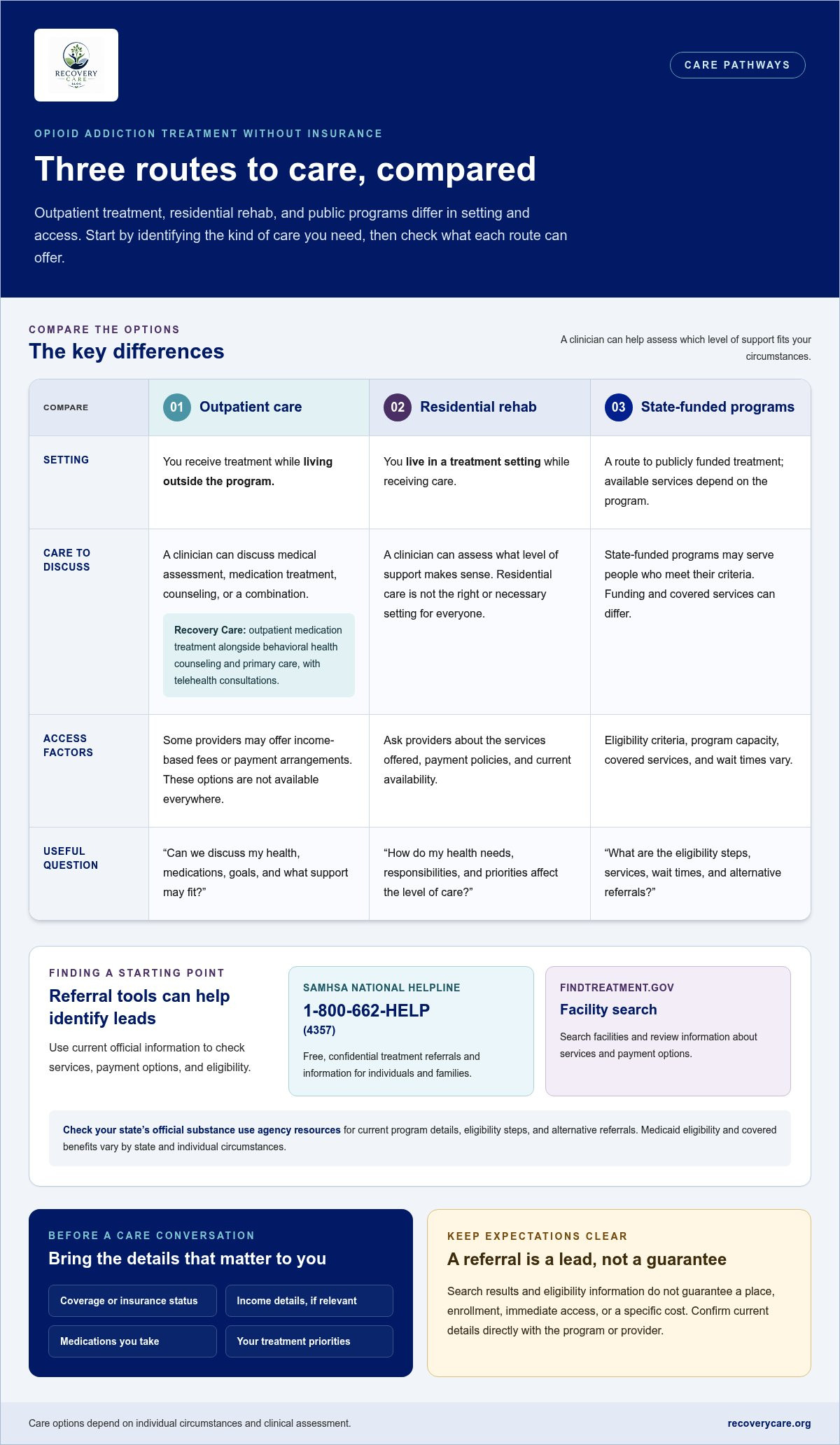
Compare Outpatient Opioid Treatment, Residential Rehab, and Public Programs
These options describe different things. Outpatient and residential care are treatment settings, while a publicly funded program is a possible way to access services that may use different settings. If you’re considering how to get help for opioid addiction without insurance, comparing the practical differences can help you prepare for a clinician conversation. This comparison cannot determine which level of care is right for you.
| Option | Setting and typical structure | Access considerations | Questions to discuss with a clinician |
|---|---|---|---|
| Outpatient care | Scheduled visits while you continue living in the community. Care may include medical appointments, medication treatment, and counseling. | Services, appointment availability, and payment policies vary by provider. | Could outpatient care address my needs? What treatment and follow-up might be part of a plan? |
| Residential rehab | You live at a treatment facility and receive care within that setting. | Eligibility, services, costs, and openings differ among programs. | Would living in a treatment setting be appropriate for my clinical and safety needs? |
| Publicly funded programs | A funding route, not one specific setting. Depending on the program, services may use different treatment formats. | Criteria, capacity, covered services, and wait times can vary. | Which services could I qualify for, and what alternatives can I consider if access is delayed? |
How outpatient medication treatment differs from residential rehab
Outpatient care is scheduled treatment while a person remains in the community, rather than living at a facility. Residential rehab means staying at a treatment facility as part of the program. Neither label alone tells you what care will involve or whether it fits your situation. This is general information, not a substitute for an individual clinical assessment.
Practical needs can shape the conversation, too. Work, caregiving, transportation, health concerns, and available support may affect what feels manageable, but they don’t replace clinical guidance. A qualified clinician can assess your circumstances and discuss an appropriate level of care, including safety considerations and possible next steps.
Where medication and counseling fit
Medication treatment for opioid use disorder is provided under medical supervision. Suboxone, Subutex, Sublocade, and Vivitrol are treatment options that require clinical evaluation. A clinician can assess whether a medication approach may be suitable for you. Counseling may also be included in a broader, individualized recovery plan, alongside medical care and support for personal goals.
There’s no single best setting for everyone. Describe your health needs, daily responsibilities, and access concerns, then discuss how available options address them. That conversation can help turn a broad search into a more specific care plan, without assuming that residential treatment is necessary or that outpatient care is automatically sufficient.
Take These Steps to Seek Opioid Addiction Help Without Coverage
Finding a workable route can take more than one step. Preparing a few details and keeping alternatives open can make the process easier. If you’re wondering how to get help for opioid addiction without insurance, use this sequence to move from immediate safety to a focused care conversation.
- Address immediate danger first. For a suspected overdose or other medical emergency, call 911. If Naloxone is available, follow its instructions. Urgent safety concerns take priority over paperwork or routine appointment planning.
- Write down your current coverage status. Note whether you’re uninsured, applying for Medicaid, or eligible for Medicare. Add basic income information if you’re exploring a public program or an income-based fee option.
- Gather health and treatment details. List current medications, relevant health concerns, and any prior treatment experience. Include the support you’re seeking, such as medication treatment, counseling, or care that fits around daily responsibilities.
- Explore more than one appropriate route. Use a public program and national referral resources to identify possible options. If one route has a waitlist or eligibility barrier, look for alternatives rather than relying on a single application.
- Start a care conversation. Share your needs, circumstances, and priorities with a qualified clinician. Discuss which treatment approaches may be appropriate and what the next step would involve.
Prepare for a first call or appointment
Keep your notes together so you don’t have to remember everything in the moment. Say plainly, “I’m uninsured and need to understand affordable options.” Then discuss which services are involved, what payment information is available, and whether care may be in person or by telehealth. Asking about payment is a valid first step, not something to feel uncomfortable about.
Keep moving if the first route is not available
A waitlist or eligibility barrier doesn’t answer every question about your care. Revisit SAMHSA’s referral resources or your state’s official program information and pursue other suitable leads in parallel. Telehealth may be a possible format for some care, depending on applicable requirements and individual circumstances. For more context, see the guide Telehealth Addiction Counseling: A Comprehensive Guide to Virtual Recovery.
Bring your questions to a care conversation, even if your notes are incomplete. Recovery Care provides outpatient opioid treatment alongside behavioral health counseling and primary care, with telehealth consultations available. Learn more about Recovery Care’s outpatient opioid treatment and care options.
How Recovery Care Supports People Seeking Opioid Addiction Treatment
Cost and coverage questions can make it harder to reach out, but you don’t need to have every detail settled before starting a care conversation. Recovery Care provides outpatient medication-assisted treatment for opioid addiction, with behavioral health counseling and primary care as part of a broader approach. If you’re considering how to get help for opioid addiction without insurance, you can discuss your circumstances and learn about care options. Treatment is not necessarily free, and costs depend on individual circumstances and services.
Recovery Care accepts most major insurance plans, Medicare, and Medicaid. Coverage and costs depend on individual circumstances and services. If you’re uninsured, explain your situation and discuss the care options that may fit. Telehealth consultations and in-person care are available; telehealth depends on applicable requirements and individual circumstances.
What outpatient support at Recovery Care can include
Outpatient medication treatment allows you to receive care while continuing to live in the community. A clinician can evaluate your needs and discuss medication treatment and ongoing management. Recovery Care offers Suboxone, Subutex, Sublocade, and Vivitrol as treatment options that require clinical evaluation. Naloxone is also among the clinic’s medication offerings.
Medication is one part of care. Behavioral health counseling may complement medical treatment by giving you space to discuss challenges, coping strategies, and personal goals. Primary care can also support attention to your general health. Care is individualized, and a clinician can help you understand which services may fit your needs.
If you’re learning about one medication option, the guide Suboxone Treatment: A Comprehensive Guide to Opioid Recovery in 2026 offers further context about Suboxone treatment. Reading about an option can help you prepare questions, but a clinician’s evaluation is needed to determine whether it’s appropriate for you.
A compassionate next step, even if you are uninsured
It can feel difficult to bring up cost, especially if you’re worried about being turned away. You can start simply: explain that you’re uninsured, describe the care you’re looking for, and discuss your circumstances. You don’t need a complete treatment history or to know which medication is right before reaching out.
Counseling may also be part of a plan alongside medication treatment or other medical support. The guide Opioid Addiction Counseling: 2026 Behavioral Health Guide can help you understand how behavioral health support may fit into treatment. Use it to identify questions you’d like to raise in a care conversation.
Take one manageable step: contact Recovery Care to discuss outpatient opioid addiction treatment and your next step. Share your coverage concerns and discuss care options. A conversation can help clarify what to consider next, without requiring you to decide everything at once.
Take One Supported Step Toward Care
Starting a conversation doesn’t commit you to a particular treatment plan. It gives you a chance to share what you need, discuss the concerns that feel hardest to address, and learn what a reasonable next step could look like. If you’re still considering how to get help for opioid addiction without insurance, begin with a question about care options and your circumstances.
Recovery Care’s outpatient medication-assisted treatment and behavioral health counseling are led by Medical Director Dr. Heather Rosen, MD. The clinic offers in-person care and telehealth consultations, with telehealth subject to individual circumstances. You can explain your needs and discuss whether this approach may fit what you’re looking for.
Explore compassionate outpatient opioid treatment with Recovery Care and start a conversation about your next step. Seeking help takes courage, and you deserve to be met with respect as you move forward.
Frequently Asked Questions
Can I get opioid addiction treatment without health insurance?
Yes. Lack of insurance doesn’t automatically prevent you from seeking opioid addiction care. Public programs, community health centers, nonprofit resources, and providers with self-pay options may be possible routes to explore. As you consider how to get help for opioid addiction without insurance, explain your coverage situation early and review available services and payment information before arranging care. You can explore more than one resource at a time.
Is medication-assisted treatment available to people without insurance?
It may be, depending on the program, provider, and your clinical needs. A clinician can assess whether medication treatment is suitable and explain the care involved. Publicly funded programs or providers with income-based fees may be worth investigating, but access and costs vary. Don’t assume medication or appointments will be free; review how treatment and medication costs are handled before making a plan.
How can I find free or low-cost opioid addiction treatment?
Start with SAMHSA’s National Helpline or FindTreatment.gov, then explore your state’s substance use agency resources and community health centers. In an online search, terms such as “opioid use disorder,” “outpatient medication treatment,” and “sliding scale” can help narrow results. Treat listings as leads, not guarantees. Review the services described and current eligibility, access, and payment details before pursuing an option.
Does Medicaid cover opioid addiction treatment?
Medicaid covers substance use treatment for eligible people, but covered services and eligibility rules vary by state and individual circumstances. Check your state Medicaid agency’s official guidance for current enrollment information and benefits. If you’re already enrolled, review your plan details to understand how a specific service is handled. Eligibility alone doesn’t confirm that a particular provider or treatment service is covered.
What happens if a state-funded treatment program has a waitlist?
Look for information on alternative resources, cancellation lists, and what to do while you wait. You can also keep exploring other appropriate options, such as another public program or a community health center, rather than relying on one referral. If your health or safety becomes an immediate concern, seek urgent medical help. A waitlist shouldn’t prevent you from discussing next steps with a clinician.
Can I get Suboxone without insurance?
Possibly, but a qualified clinician must evaluate whether Suboxone is appropriate for you and explain the treatment plan. Without insurance, review what appointment and medication costs may involve, whether those charges are separate, and what payment information is available. Public programs may also be a route to explore. Don’t use someone else’s medication or change a prescribed treatment without medical guidance.
Is telehealth an option for opioid addiction treatment without insurance?
Telehealth may be an option for some people, depending on location, clinical needs, and applicable requirements. It can allow a person to discuss treatment with a clinician remotely, but it doesn’t mean every service or medication can be provided virtually. Review how a telehealth visit is arranged and what costs or coverage may apply. If you’re experiencing an emergency or suspect an overdose, call 911 rather than relying on a routine virtual appointment.


