

What if the medication price is only one part of your MAT budget? The cost of MAT without insurance can be difficult to estimate because treatment may involve more than medication alone. Clinical visits, counseling, relevant testing, the medication prescribed, and how often care is needed can all affect what you pay.
If you’re worried that being uninsured puts treatment out of reach, it’s understandable to want clear information before taking the next step. There isn’t one standard total for every care plan, but knowing what contributes to the cost can make your options easier to compare. This 2026 guide explains the expenses to consider, what to look for in payment information, and practical ways to plan for out-of-pocket care.
You’ll also learn how medication formats, including Suboxone, Sublocade, and Vivitrol, may affect the questions to discuss about a treatment plan. Recovery Care provides outpatient medication-assisted treatment, behavioral health counseling, primary care, and telehealth consultations. A conversation about your needs and budget can help you understand the care options available to you.
Key Takeaways
- The cost of MAT without insurance depends on the care plan, not just the medication. Clinical visits, counseling, and testing may also affect out-of-pocket spending.
- Compare care options by separating medication costs from clinic-administered treatment and ongoing visits.
- Before comparing payment options, find out what’s included, what may be billed separately, and how often care is scheduled.
- Review whether Medicaid, Medicare, or a private plan may be an option for you, since coverage can change how you plan for care.
- Recovery Care offers outpatient MAT, behavioral health counseling, primary care, and telehealth consultations to support conversations about treatment needs and payment questions.
Cost of MAT Without Insurance: Why There Is No Single Standard Amount
It’s reasonable to want a clearer picture of the cost before getting started. A useful estimate begins with the care plan, not a generic monthly figure. Medication-assisted treatment (MAT) combines medication with clinical support, with the plan shaped around a person’s treatment needs. The services involved and how often they’re needed can differ from one person to another.
That’s why there isn’t one national amount that represents every MAT medication, appointment, and treatment plan. A figure that leaves out counseling or professional visits, for example, may not reflect the full care someone is considering. This guide explains possible cost components and how to interpret an estimate. It isn’t a personal quote or a promise of what any individual’s care will cost.
What does “cost of MAT” usually refer to?
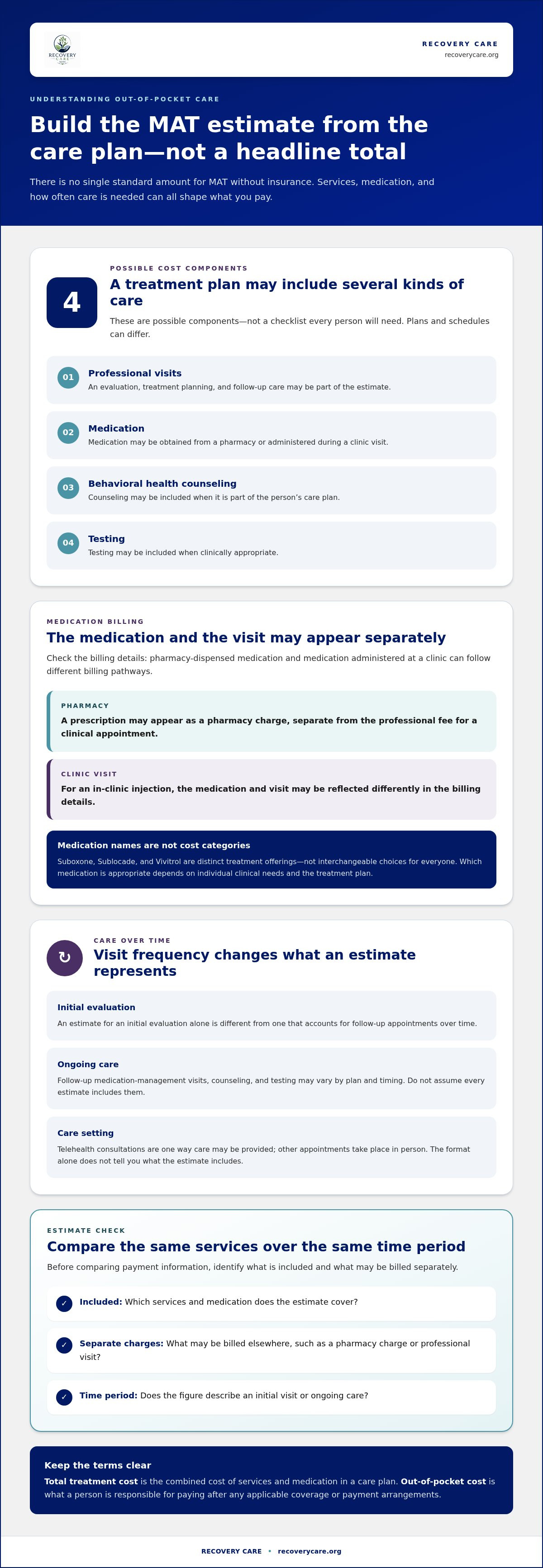
Total treatment cost is the combined cost of services and medication in a care plan. Out-of-pocket cost is the amount a person is responsible for paying after any applicable coverage or payment arrangements. Without insurance, it’s especially helpful to understand what an estimate includes and what may be billed separately.
Depending on the plan, costs may involve:
- Professional visits for an evaluation, treatment planning, or follow-up care
- Medication, which may be obtained from a pharmacy or administered during a clinic visit
- Behavioral health counseling, when it’s part of the person’s care
- Testing, when clinically appropriate
These are possible components, not a checklist every person will need. One person’s plan may involve different visits or services than another’s. To compare estimates fairly, note which items apply and whether the figures cover the same services and time period.
Why can uninsured patients see different estimates?
The medication selected can affect how an estimate is structured. A prescription filled at a pharmacy may appear as a pharmacy charge, while a medication administered during a clinic visit may be billed through the clinic. The professional visit and medication may be separate charges, so a single figure may not include both.
Visit frequency matters, too. An estimate based on an initial evaluation alone will look different from one that accounts for follow-up appointments over time. The care setting can also shape how services are delivered and billed. Telehealth consultations are one way care may be provided, while other appointments take place in person. The format alone doesn’t tell you what an estimate includes.
When reviewing payment information, look at the details: which services are included, which may be billed separately, and whether the estimate reflects an initial visit or ongoing care. Compare the same services over the same time period, and note any items that aren’t covered in the figure. This gives you a more useful picture of the cost of MAT without insurance than a broad total that may not fit your needs.
What Can Shape the Cost of MAT Without Insurance?
The cost of MAT without insurance depends on which services are part of a person’s treatment plan and how those services are delivered. Instead of relying on a headline total, look at each category separately. This makes it easier to see what an estimate includes and identify costs that may appear elsewhere.
A treatment plan may include an initial clinical evaluation, follow-up visits, medication, counseling, or testing when appropriate. Not every person needs every component, and the schedule can vary. For example, one estimate might describe medication only, while another may include a professional visit as well. Neither total is easy to interpret without knowing what it covers.
Medication and administration are not always billed the same way
Prescription medication dispensed by a pharmacy and an injection given during a clinic visit can involve different billing pathways. A pharmacy charge may be separate from the professional fee for a clinical appointment. For an in-clinic injection, the medication and visit may be reflected differently in the billing details. Check each estimate for what it includes rather than assuming the medication and related care are combined.
Suboxone, Sublocade, and Vivitrol are distinct treatment offerings, not interchangeable cost categories or choices for everyone. Which medication is appropriate depends on an individual’s clinical needs and treatment plan. SAMHSA's guide to Medication-Assisted Treatment offers background on MAT and common medication approaches. For more context on one medication option, see this Suboxone treatment guide.
Visits, counseling, and testing can affect the total
An evaluation and follow-up medication-management visits are separate parts of care to account for when reviewing an estimate. How often visits occur can shape the total over time, so note whether a figure covers one appointment or a series of visits. Counseling and diagnostic testing may also be included when they’re relevant to a person’s plan. Their inclusion and timing can differ, so don’t assume they’re part of every estimate.
Compare like with like. Put each estimate into the same categories, then mark whether each component is included, billed separately, or not part of the plan. Useful categories include:
- Clinical evaluation and follow-up visits
- Medication and, if applicable, administration during a clinic visit
- Behavioral health counseling
- Testing included in the treatment plan
This breakdown can reveal why two totals differ without suggesting that one figure represents everyone’s care. At Recovery Care, outpatient MAT, behavioral health counseling, and related care are part of the conversation about your needs. You can talk through how medication, visits, and counseling fit into care.
How to Compare MAT Care Options When You Are Uninsured
Being uninsured doesn’t, by itself, explain what a treatment plan will involve or what it will cost. Make a useful comparison by looking beyond a headline total and recording the same service categories for each option. This helps show whether two estimates describe similar care or different combinations of visits, medication, and support.
Compare outpatient MAT with other treatment settings
Outpatient MAT involves scheduled treatment visits without an overnight residential stay. Inpatient rehabilitation uses a residential setting and a different service structure. Since the settings and included services differ, comparing only their headline totals can be misleading. A fair comparison requires figures for similar services and a time period that reflects the specific care being considered.
Lack of insurance doesn’t mean you should assume one setting is your only option. First, identify the kind of care being discussed, then compare the services included within that setting. Recovery Care provides outpatient MAT through in-person care and telehealth consultations.
Compare treatment plans, not medication names alone
A medication name doesn’t show the full structure of care. Meaningful comparisons account for how medication is provided, how often visits are scheduled, and whether counseling or testing is part of the plan. Medication decisions should follow an individualized clinical evaluation, not a price comparison alone. For context on a long-acting treatment option, explore this Sublocade injection guide.
Use a simple table to line up the details. Answer the same questions for each option, and note when a service is included, billed separately, or scheduled to continue over time.
| Care component | What to compare |
|---|---|
| Outpatient visits | Is an evaluation included? What follow-up visits are planned, and how often? |
| Medication | Is it obtained through a pharmacy or administered during a clinic visit? Is its cost listed separately? |
| Counseling | Is counseling part of the plan, and is it included or separately billed? |
| Testing | What testing is included, if any, and when might it be scheduled? |
For example, one option may show a lower total because it covers fewer services or only an initial appointment. Another may include ongoing visits or additional care components. Neither number tells the whole story until you know what the estimate covers and what may be billed separately. Compare the same time period and service categories wherever possible.
As you review the cost of MAT without insurance, keep the comparison focused on the plan, not a medication name alone. A conversation with Recovery Care about outpatient MAT options can bring treatment needs and payment questions into the same discussion.
Ways to Plan for MAT Costs Without Insurance
Planning can feel more manageable when you turn a broad cost question into a short list of details to gather. You don’t need every answer before discussing care. A written comparison can help you understand what an estimate covers, what may be billed separately, and which payment questions you still have.
A practical checklist for understanding expected charges
Use the same categories for each option you’re considering. Note whether each service is included, billed separately, or scheduled as ongoing care. This helps prevent comparing an estimate for one visit with a plan that includes multiple services.
- List the planned services. Record evaluation and follow-up visits, medication, counseling, and any testing included in the treatment plan.
- Note how medication is provided. Distinguish a prescription dispensed through a pharmacy from medication administered during a clinic visit, and record whether related charges are separate.
- Track visit timing. Write down which appointments are part of the initial plan and what ongoing care may be scheduled. Avoid comparing totals that cover different time periods.
- Clarify billing details. Review what payment information is available before beginning care, including which services may be billed together or separately. An estimate can help with planning, but it isn’t necessarily a fixed quote for every service or future visit.
- Keep the details together. Use one comparison sheet for service categories, medication pathway, visit schedule, and billing information.
Explore coverage and other potential payment routes
Being uninsured now doesn’t always mean you’ll remain uninsured. Whether you may qualify for Medicaid, Medicare, or a private plan depends on your circumstances and the plan’s eligibility requirements. Recovery Care accepts most major insurance plans, Medicare, and Medicaid. If you’re exploring whether coverage may apply, the guide to Medicaid and Suboxone care may help you understand the connection between coverage and treatment.
Public or community assistance may also be available in some circumstances, but programs can differ in eligibility, funding, and availability. Review current program details before including possible assistance in your budget. Don’t assume a program is open or that you qualify based on a general description.
With the service list and payment questions in hand, you can have a more focused conversation about the cost of MAT without insurance. Share what you know, identify what remains unclear, and discuss how your treatment needs relate to the services involved. For a conversation about outpatient MAT, counseling, primary care, telehealth, and payment questions, explore care options with Recovery Care.
Discuss Your MAT Options With Recovery Care
Once you’ve gathered your questions, you don’t have to figure out every detail on your own. A conversation about your treatment needs, the services involved, and payment concerns can help you understand what to consider next. Asking about the cost of MAT without insurance is a practical part of planning, not a commitment to begin care.
What a first conversation can help clarify
Share what you’re hoping to address, what kind of support you’re looking for, and whether you currently have insurance. If you have a comparison sheet or estimate, it can help organize the discussion, but you don’t need to arrive with everything figured out.
Questions about medication, visits, counseling, testing, and how services are billed are normal. Recovery Care provides outpatient medication-assisted treatment, behavioral health counseling, and primary care. Treatment offerings include Suboxone, Sublocade, and Vivitrol. A clinical evaluation helps guide care based on your individual needs, while discussing the services involved can help you understand what to include in your planning.
Recovery Care accepts most major insurance plans, Medicare, and Medicaid. Acceptance doesn’t mean every plan or service is covered, so share your coverage information and discuss payment questions alongside your care needs. If you’re uninsured, say so. That context helps keep the conversation focused on the information that matters to you.
Choose a care format that supports your next step
Care is available in person and through telehealth consultations. The format is one part of planning, alongside your clinical needs and the services in your treatment plan. Telehealth is a care option, but it doesn’t by itself determine fees, coverage, or eligibility. For additional context about virtual support, explore this telehealth addiction counseling guide.
To make the conversation useful, you might bring questions such as:
- Which treatment and support services should I consider based on my needs?
- How are medication, visits, counseling, and any relevant testing handled in the care plan?
- What payment information can I review before deciding on next steps?
- Would in-person care or a telehealth consultation be a suitable format to discuss my needs?
You deserve a respectful conversation about both care and cost. You can take things one question at a time and decide what feels right for your next step. Explore MAT care options with Recovery Care and discuss your treatment needs, service questions, and payment concerns together.
Take the Next Step at Your Own Pace
Financial questions don’t need to be fully resolved before you begin exploring care. Start with one manageable step: identify the detail you most need clarified, whether that’s how a service is billed, what your coverage may apply to, or what care could look like for you. A clearer understanding of the cost of MAT without insurance can grow through conversation, one question at a time.
Seeking information doesn’t obligate you to make a decision today. It gives you space to understand your options and consider what feels appropriate for your needs. If you’re ready to explore support, Recovery Care offers a compassionate place to begin the conversation.
Explore MAT care options with Recovery Care. Ask your questions about care and payment, then decide on a next step that feels right for you.
Frequently Asked Questions
How much does MAT cost without insurance?
There isn’t one amount that applies to every person. The cost of MAT without insurance depends on the treatment plan and how its services are billed. To make an estimate more useful, check what time period it covers and whether it reflects an initial appointment or continuing care. Compare estimates for the same period and confirm whether medication is included or handled through a separate pharmacy charge.
Can I start MAT if I do not have insurance?
Lack of insurance doesn’t automatically determine whether you can access care, but payment options depend on the care arrangement. Explain that you’re uninsured and discuss the payment information for the services being considered. Recovery Care can discuss treatment needs and accepted coverage options without assuming that you qualify for a discount or assistance program. You can gather information first, then decide what feels manageable.
Does Medicaid cover medication-assisted treatment?
Medicaid may cover MAT, but coverage depends on your eligibility, state program, and the specific medication and services involved. Recovery Care accepts Medicaid, though acceptance doesn’t mean every service or medication is covered under every plan. Review your current plan information and discuss how it applies to the care you’re considering. Keep notes on any differences between medication, professional visits, and other services.
Is outpatient MAT different from inpatient rehab?
Yes. Outpatient MAT involves scheduled clinical care while you live outside a residential facility. Inpatient rehabilitation involves staying in a residential treatment setting with a different service structure. These aren’t directly comparable based on cost alone, since the care delivered and setting differ. A clinician can discuss what level of care may suit your needs. Financial concerns are worth raising, but they shouldn’t be the only factor in that clinical discussion.
Can telehealth be used for MAT when I do not have insurance?
Telehealth may allow you to have consultations remotely, but whether it fits your care and how it’s billed depend on the arrangement. Don’t assume a virtual appointment is free or less expensive than an in-person visit. Recovery Care offers telehealth consultations, and you can include questions about the format in a discussion about your treatment needs. Discuss payment information for the consultation and any related services.
What should I ask about before beginning MAT without insurance?
Ask for a breakdown that distinguishes charges for professional care from pharmacy purchases. Clarify whether an estimate is for one appointment or ongoing care, and whether follow-up scheduling could change the services you use. If you’re considering coverage, have your plan details available so you can ask focused questions. These steps can help you spot missing information before making a decision, without treating an estimate as a guarantee.


