
What if counseling could be one supportive part of recovery, rather than a test you have to pass? If you’re unsure what happens in a session, worried about being judged, or wondering how emotional support connects with addiction treatment, those questions are understandable. Behavioral health services can look different from person to person. Learning what they involve can make getting support feel more manageable.
These services may include individual or group counseling focused on substance use and mental health. Counseling can complement addiction treatment by giving you a place to discuss challenges, identify what you want help with, and consider supportive steps as part of a broader recovery plan. It isn’t about blame, and one approach won’t fit everyone.
This article explains the kinds of support behavioral health care may involve, how counseling can sit alongside addiction treatment, and how to prepare for a first conversation. Recovery Care offers behavioral health counseling alongside outpatient medication-assisted treatment and primary care. You can start by learning about your options and noting what you’d like to discuss.
Key Takeaways
- Behavioral health services can support concerns involving emotions, coping, relationships, substance use, or daily life.
- Individual and group counseling offer different ways to explore substance use and mental health support.
- Counseling, outpatient medication-assisted treatment, and primary care have distinct, potentially complementary roles in a recovery plan.
- Before exploring care, jot down your concerns, support preferences, goals, and questions about next steps.
- Recovery Care brings behavioral health counseling together with outpatient addiction treatment, primary care, and telehealth consultations.
What Are Behavioral Health Services, and Who Might Find Them Helpful?
Looking for support can feel unfamiliar, especially if you’re unsure what you’ll be asked or whether your concerns are serious enough. In plain language, behavioral health refers to how thoughts, feelings, habits, relationships, and substance use can affect everyday life. Behavioral health services can provide a place to talk through those experiences and consider what support may fit your needs.
There isn’t one standard reason to seek care. Someone might want help coping with stress, making sense of changes in mood, improving communication at home, or addressing substance use as part of recovery. These examples aren’t diagnoses, and no single concern automatically points to one kind of care. Support can be tailored to the person and may take place in individual or group counseling. A broad overview of care settings and related supports is available in this Mental health service reference.
Behavioral health and mental health: how are they related?
The terms overlap, and people may use them differently. Mental health often describes emotional, psychological, and social well-being. Behavioral health can include those areas while also drawing attention to habits and actions, including substance-use concerns. For example, someone may notice that worry makes it hard to sleep, conflict with a loved one is becoming difficult to manage, or alcohol or drug use is affecting routines. These experiences are not character flaws or personal failures. They may be reasons to explore support.
Behavioral health counseling offers a structured conversation about concerns and possible goals. General information can explain common concepts, but it can’t assess an individual or determine what care is appropriate. Diagnosis and personalized medical guidance require a qualified clinician who can consider a person’s circumstances.
When might someone consider behavioral health support?
You don’t have to wait for a crisis to consider talking with someone. A person may seek support when distress persists, coping feels harder than usual, relationships or everyday responsibilities are affected, or they want added support during recovery. It’s a personal choice, and asking questions can be a reasonable first step.
If a concern is affecting daily life, consider discussing it with a qualified clinician. Describe what you’ve noticed in ordinary terms, such as feeling overwhelmed at work, having trouble keeping up with routines, or wanting support around substance use. For individuals navigating challenges with focus and emotional regulation, specialized practices such as Collins Psychology offer targeted behavioral programs. You don’t need a diagnosis or a perfectly formed explanation. A clinician can help explore what you’re experiencing and discuss possible next steps without judging your worth.
What Can Behavioral Health Services Include?
Support can take more than one form. Recovery Care offers individual and group behavioral health counseling focused on substance use and mental health support. Counseling gives you a setting to talk through concerns, reflect on what matters to you, and consider goals with a clinician. There’s no single format or plan that suits everyone.
Individual and group counseling: what is the difference?
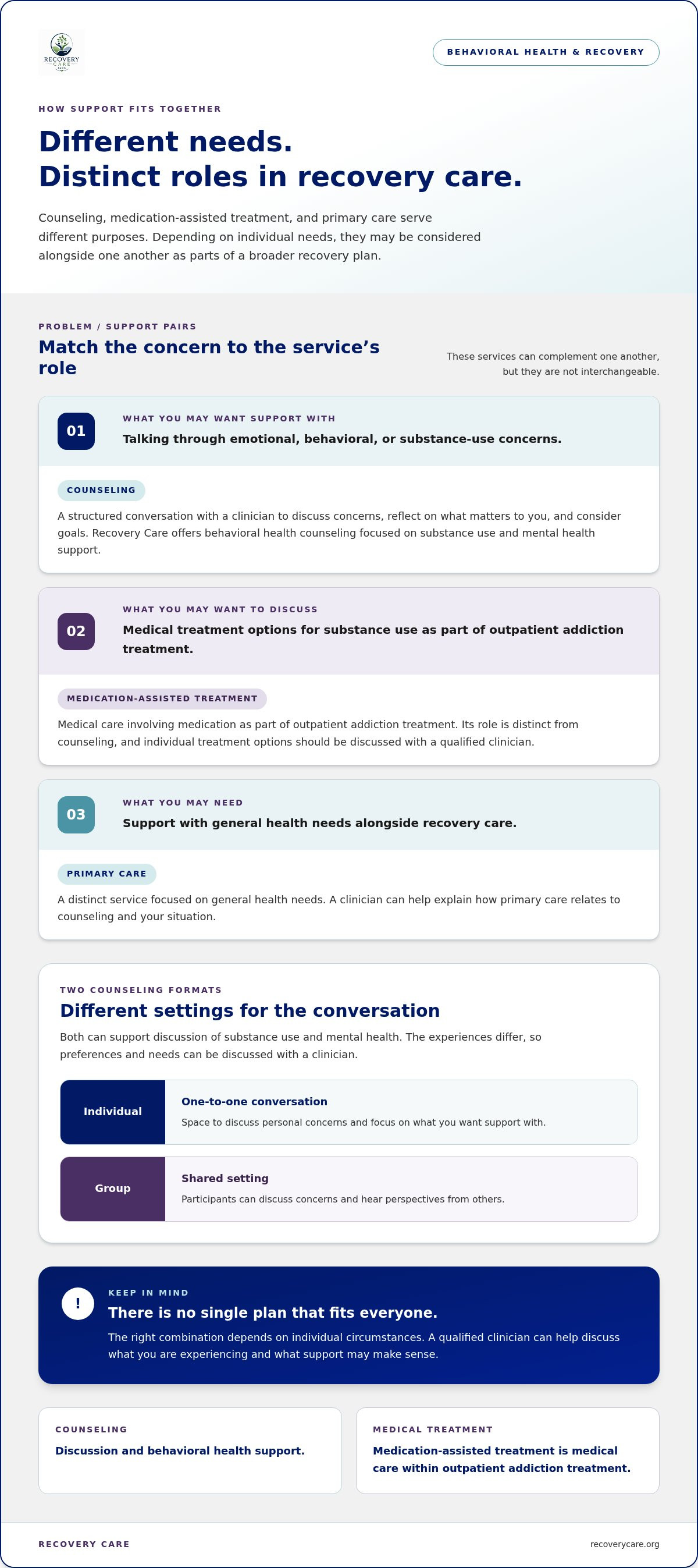
Individual counseling is a one-to-one conversation between you and a clinician. It gives you space to discuss personal concerns and focus on what you want support with. Group counseling creates a shared setting where participants can discuss concerns and hear perspectives from others. The experiences differ, so you can discuss your needs and preferences with a clinician when considering which format fits.
You don’t have to know exactly what to say beforehand. You might begin by describing a concern, a change you’d like to work toward, or a question about recovery. For those looking to better identify what they are experiencing, resources from Balanced Minds Psychology & Wellness on emotional labeling can offer useful guidance for putting feelings into words. Counseling can address substance use and mental health without reducing a person to a diagnosis or a difficult moment.
How counseling can complement addiction treatment
Counseling and medication-assisted treatment have distinct roles. Counseling provides a space for discussion and behavioral health support. Medication-assisted treatment is medical care involving medication as part of outpatient addiction treatment. Depending on a person’s needs, these services may be considered alongside one another as parts of a broader recovery plan, rather than as interchangeable services. Recovery Care provides behavioral health counseling alongside outpatient addiction treatment.
For example, someone might want counseling while also discussing medical treatment options for substance use. The right combination depends on individual circumstances and should be discussed with a qualified clinician. A guide to opioid addiction counseling can help you learn more about how counseling may relate to recovery support.
Primary care is another distinct service that may accompany counseling. It focuses on general health needs, while counseling centers on emotional, behavioral, and substance-use concerns. A clinician can explain how these services relate to your situation. Behavioral health services are not a one-size-fits-all package; the aim is to identify what support makes sense for you.
To explore counseling and treatment options, visit Recovery Care’s counseling and treatment services and note what you’d like to discuss.
How Behavioral Health Support Fits Into a Broader Recovery Plan
Recovery can involve more than one kind of care, but that doesn’t mean everyone needs the same combination. Counseling, medication-assisted treatment, and primary care serve different purposes. A care team can discuss how these services may work alongside one another based on your needs and preferences. A recovery plan can bring together services that reflect a person’s goals and circumstances.
Counseling, medication, and primary care: different roles
Counseling offers behavioral and emotional support, including space to discuss substance use and mental health concerns. It can be part of a recovery plan, but it isn’t a substitute for medical evaluation. Medication-assisted treatment is clinician-managed addiction care that involves medical decisions about whether medication is appropriate. Primary care addresses general health needs and can be a separate part of a person’s overall care.
Here’s a simple way to understand how each service might come up in a conversation with a care team:
| Service | General purpose | Example of when it may be discussed |
|---|---|---|
| Counseling | Behavioral and emotional support | When you want to talk about substance use, mental health, or challenges affecting daily life |
| Medication-assisted treatment | Clinician-managed addiction care | When discussing medical options as part of outpatient addiction treatment |
| Primary care | Support for general health needs | When you want to discuss a health concern alongside recovery care |
The examples are starting points for discussion, not a checklist or a recommendation. A clinician can help explain which services may be relevant to your circumstances. Decisions about medication, including whether to use it, should be made with a qualified medical professional who can consider your health needs.
For another perspective on the role of general health care in recovery, explore this primary care for recovery guide. Understanding the distinct roles of care can help you bring focused questions to a conversation with your care team.
Why care plans should reflect individual needs
People may come to care with different concerns, priorities, and preferences. One person may want to focus on counseling, while another may have questions about medication-assisted treatment or a general health issue. Needs and goals can also change, so the services discussed at one point may not be the only ones considered later. Behavioral health services can be one part of a broader plan, rather than a fixed package.
Share what matters to you with your care team. You might ask how counseling relates to medical care, what a medication decision involves, or how primary care could fit into the discussion. Recovery Care offers behavioral health counseling alongside outpatient addiction treatment and primary care, bringing these services into one care setting. Learn more about Recovery Care’s care options and note the questions you’d like to raise.
What to Consider When Exploring Behavioral Health Care
Taking a first step doesn’t require having every answer. A little preparation can help you explain what’s on your mind and understand your options through Recovery Care. Use this simple sequence to organize your thoughts:
- Identify your concerns. Note what’s been difficult lately, such as managing stress, navigating substance use, or keeping up with daily responsibilities.
- Consider your preferences. Think about whether individual or group counseling feels more comfortable to discuss, and whether you have questions about in-person care or telehealth consultations.
- Discuss your options. Share what you hope to address and ask how counseling could relate to your broader recovery goals and other care.
- Clarify next steps. Before ending the conversation, make sure you understand what happens next and which questions still need answers.
This isn’t a test or a commitment to a particular plan. It’s a way to make the conversation feel more manageable and help your care team understand what matters to you.
Questions to bring to an initial conversation
Describe what has been difficult in your own words, even if you’re still sorting out how to explain it. Consider asking what individual or group counseling involves, how counseling might support your recovery goals, and how different services could fit together. If you have practical concerns about access or insurance, bring those up too. Coverage and benefits vary by plan and service, so review your plan’s behavioral health coverage and don’t assume a service is covered.
It may help to write down a few questions beforehand, such as “What would we focus on first?” or “How might counseling relate to other care I’m receiving?” You can also share what kind of support feels comfortable or what you’re unsure about. A clear, respectful conversation can help you understand possible next steps without requiring a diagnosis or a fully formed plan in advance.
In-person care and telehealth considerations
Recovery Care offers in-person care and telehealth consultations. As you consider format, think about what feels comfortable, what fits your schedule, and where you’d have enough privacy for a conversation. Sharing these preferences can help guide the discussion. You can also explore this telehealth addiction counseling guide for more context about virtual recovery support.
Writing down concerns and questions can make behavioral health services easier to explore, but you don’t need to prepare perfectly. If you’re ready to discuss counseling, recovery goals, or care options, connect with Recovery Care to take a manageable next step.
How Recovery Care Brings Behavioral Health Support Into Recovery
Finding support can begin with a conversation, not a fully formed plan. Recovery Care provides individual and group behavioral health counseling focused on substance use and mental health support. These options give you a place to discuss concerns and consider what you’d like help with, while recognizing that each person’s needs and preferences are different.
Counseling is one part of the care Recovery Care provides. Outpatient addiction treatment, primary care, and telehealth consultations are also available. Each service has a distinct role, and a care team can help you understand how they may relate to your concerns. You can raise questions about one service or discuss how different kinds of support might fit your recovery goals.
A compassionate, coordinated approach to care
Care should treat you with dignity and respect. Recovery Care’s approach makes room for a nonjudgmental conversation about what you’re experiencing and what matters to you. Counseling can be considered alongside other Recovery Care services, without assuming that everyone needs the same combination or follows the same path.
Care is led by Medical Director Dr. Heather Rosen, MD. Questions about counseling, outpatient addiction treatment, and primary care can be part of a broader discussion. Share your priorities, ask for an explanation of the services, and take time to understand the next steps that apply to your situation.
Taking a first step with Recovery Care
You don’t need to prepare a perfect explanation. It can be enough to identify one concern you’d like to discuss or say that you’re still figuring out what kind of support might feel right. If you have questions about counseling, medication-assisted treatment, primary care, or telehealth consultations, bring them to the conversation. Your questions can help clarify which options are relevant to explore.
- Think about what you’d like support with, such as substance use or mental health concerns.
- Consider whether individual or group counseling is something you want to discuss.
- Note any questions about how counseling might fit alongside other care.
Recovery Care accepts most major insurance plans, Medicare, and Medicaid. Coverage depends on your specific plan and the service, so review your benefits and discuss any coverage questions as you consider care. Understanding the details can help you plan without assuming a particular service is covered.
Exploring behavioral health services can be a manageable first step, even if you’re still deciding what you need. Explore behavioral health and recovery care to learn about options at a pace that feels comfortable.
Make Room for a First Conversation
You don’t have to know exactly what you need before you begin. A useful first step can be as simple as naming one concern, writing down a question, or deciding what you’d like to understand better. That can help turn uncertainty into a conversation, at your own pace.
Exploring behavioral health services doesn’t commit you to a particular path. It gives you a chance to learn about possible support, share what feels important, and consider what may fit your circumstances. If you’re hesitant, start with the question that feels easiest to ask. Your needs deserve to be heard with care and respect.
Recovery Care offers behavioral health and recovery support. Take a moment to consider what you’d like to discuss and what questions would help you understand your options.
Explore compassionate behavioral health and recovery support. One thoughtful question can be a meaningful beginning, and you can move forward one step at a time.
Frequently Asked Questions
What are behavioral health services?
Behavioral health services are supports that may help with emotional well-being, coping with everyday pressures, and concerns involving substance use. They can include counseling, with the type and setting shaped by a person's needs. Counseling offers a place to discuss concerns; it isn't itself a diagnosis or medical treatment. A qualified clinician can help explore options without assuming you have a particular condition.
What is the difference between behavioral health and mental health services?
The terms are closely related and are sometimes used interchangeably. Mental health often refers to emotional, psychological, and social well-being. Behavioral health may also include habits and substance-use concerns. Organizations may use these labels differently, so they aren't rigid categories that determine what support you can seek. If you're looking for help discussing mood or substance use, focus on that need and ask what kind of care is available.
Can behavioral health services support someone dealing with substance use and emotional concerns?
Yes, counseling may provide support for people discussing substance use and mental health concerns, including when both relate to their recovery goals. That doesn't mean counseling alone is the right fit for everyone. At Recovery Care, counseling is one part of care offered alongside outpatient addiction treatment. A qualified clinician can discuss your circumstances and help you understand which options may be relevant, without presuming a diagnosis or a particular treatment plan.
Does insurance cover behavioral health services?
Coverage depends on your insurance plan, the service, and your plan's benefit rules. Recovery Care accepts most major insurance plans, Medicare, and Medicaid, but acceptance doesn't guarantee that a specific counseling service is covered or that you won't have out-of-pocket costs. Review your plan's behavioral health benefits and clarify service-specific coverage details before care. Noting your questions in advance can help make the coverage conversation more focused.
Can I access behavioral health counseling through telehealth?
Recovery Care offers telehealth consultations, which provide a way to discuss care remotely. Whether a virtual format is appropriate depends on individual needs and clinical circumstances. Telehealth availability doesn't mean every counseling service, medication, or appointment is offered virtually. Discuss what format may fit your situation, and consider whether you have a comfortable, private place for a conversation.
How long do behavioral health services last?
There isn't one duration that applies to everyone. The length and frequency of support may depend on your goals, circumstances, clinical needs, and the services being discussed. Ask your care team what to expect and how progress will be reviewed. You can revisit those questions as your needs change. A conversation about timing can help set expectations without promising a specific outcome.


