
The last Sublocade injection doesn’t mean buprenorphine leaves your body right away. Levels may decline gradually over 2-8 months, so tapering off Sublocade is a slow transition, with injection spacing and withdrawal support considered as part of the plan. You deserve a clear explanation of what that timeline can look like.
If you’re considering tapering off Sublocade, you may want to know when withdrawal could begin and whether injections can be spaced farther apart. This guide explains how medication levels decline after a final injection, why symptoms may be delayed, and how clinical support can help you navigate the process.
You’ll also find an example taper schedule showing how monthly injections might shift to wider intervals. It illustrates the process, not a personal dosing plan. Use it to understand possible approaches and prepare for a conversation about care that supports your recovery.
Key Takeaways
- After a final injection, buprenorphine levels decline gradually, so withdrawal may be delayed rather than starting immediately.
- Learn what withdrawal support and ongoing monitoring can involve as your body adjusts.
- See how an example schedule spaces injections over time, and why it’s a guide rather than a personal dosing plan.
- Understand how the slow release from an injection differs from tapering sublingual buprenorphine.
How Is Sublocade Withdrawal Treated or Prevented?
U.S. insurance coverage varies by plan, so there’s no single answer. The case and plan affect cost; it’s given after a quote request.
Gradual Medication Decline
Sublocade’s depot releases buprenorphine gradually, so medication levels decline over time after the last injection. This slow release can delay withdrawal for weeks, and symptoms may first become noticeable about a month after stopping. Because of this delay, it can be hard to connect changes with an injection. While tapering off Sublocade, track withdrawal symptoms and cravings, then discuss them with your doctor. Your notes can help your care team tailor follow-up to your experience.
Monitoring During and After Discontinuation
Medical monitoring involves planned follow-up as treatment ends and after the final injection. A doctor may monitor for severe withdrawal symptoms for several months after stopping. Since symptoms can emerge weeks later, keep follow-up appointments even if the early days feel manageable. Tell your care team about new symptoms or stronger cravings so they can reassess your support. Minor physical symptoms after stopping long-acting medication may continue for up to six months, so follow-up can remain useful beyond an initial check-in.
Medication Treatment and Relapse Prevention
Medication treatment for opioid use disorder can continue as part of a supervised plan rather than ending automatically with injections. As the depot begins to wear off, a doctor may consider oral buprenorphine. Counseling and psychosocial support can complement medication treatment. Discuss cravings, symptom changes, and recovery goals with your doctor; these details help guide care as medication levels change. Ongoing supervision can keep relapse-prevention support connected to your needs during discontinuation.
For support finding treatment options, call the SAMHSA National Helpline at 1-800-662-HELP (4357) in the United States, according to the Substance Abuse and Mental Health Services Administration.
Gradual buprenorphine decline after the last injection
After a final Sublocade injection, buprenorphine levels decline gradually rather than stopping at once. Understanding this timeline can help you plan support for recovery and changing symptoms.
Transitioning to Oral Buprenorphine
Transitioning to oral buprenorphine means using a prescribed oral form as the depot injection wears off. Levels may decrease over 2-8 months, and medication can remain detectable for several months. After four to six months of treatment, remnants may be detectable in drug tests for up to one year. A doctor may offer oral buprenorphine as the injection’s effect fades. This can help maintain continuity in addiction treatment while your needs are reassessed.
Tapering Buprenorphine
Tapering buprenorphine means reducing medication gradually under medical guidance. Buprenorphine is used to treat opioid use disorder, and a taper plan considers symptoms, cravings, and recovery goals. A doctor may adjust the plan as medication levels fall, rather than treating the last injection as an immediate end to treatment. This approach can address physical and psychological changes while supporting relapse prevention. Keep track of changes in sleep, mood, and cravings to discuss at follow-up.
Comparing Sublocade and Sublingual Tapers
Sublocade releases medication from a depot, while sublingual buprenorphine is taken in oral doses. That difference changes how a taper can be managed: the injection’s levels decline slowly, while oral dosing can be adjusted as part of a clinician-guided plan. Sublocade remains active in the body for 43 to 60 days after each injection. With sublingual buprenorphine, withdrawal often begins 24 to 72 hours after the last dose and peaks within 3 to 5 days. These timelines help explain why the transitions can feel different.
If you’re considering oral medication as part of your transition, explore oral buprenorphine treatment options and discuss your goals with a doctor.
Example Sublocade taper schedule and injection spacing
An example schedule shows how injection spacing and dose may change over time. It also illustrates why a gradual transition may take months, rather than ending with one missed appointment.
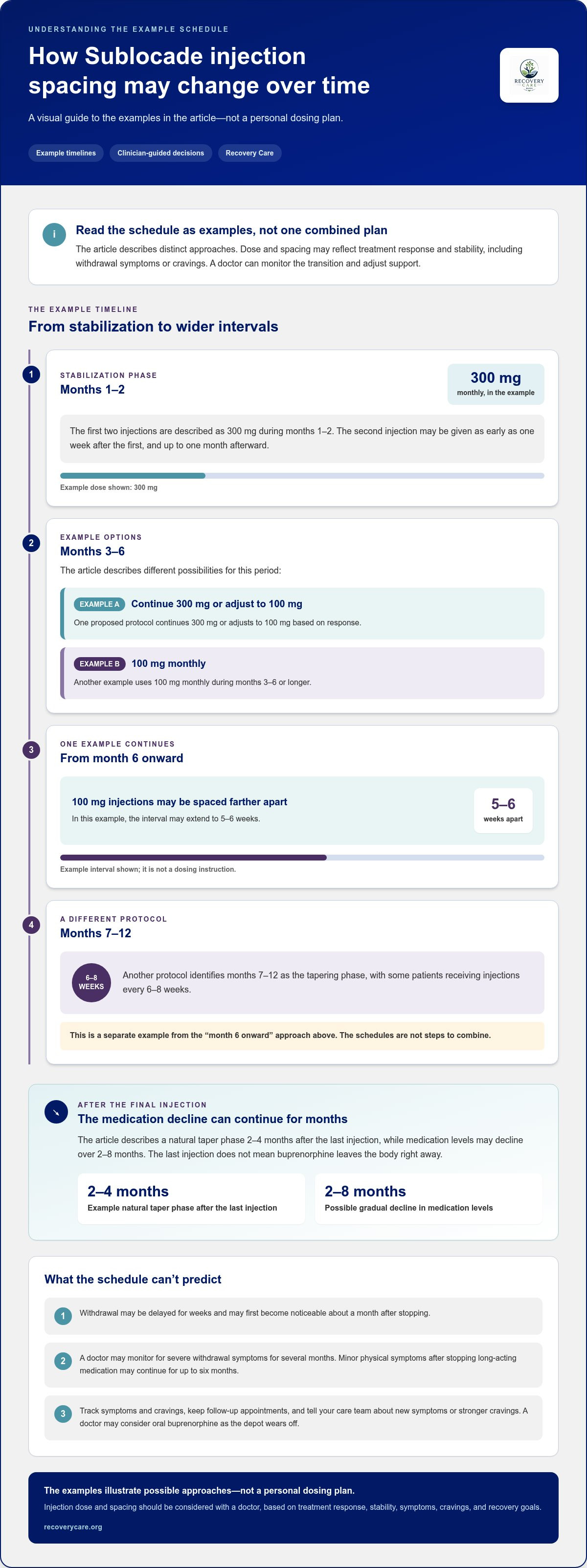
In one example, the first two injections are 300 mg during months 1-2, the stabilization phase. After the first two injections, Sublocade is given monthly. The second injection may be given as early as one week after the first, and up to one month afterward. These steps illustrate how treatment can begin before any tapering phase.
For months 3-6, one proposed protocol continues 300 mg or adjusts to 100 mg based on response. Another example uses 100 mg monthly during months 3-6 or longer. From month 6 onward, that example may extend the interval between 100 mg injections to 5-6 weeks. A different protocol identifies months 7-12 as the tapering phase, with some patients receiving injections every 6-8 weeks.
- Months 1-2: An example stabilization phase uses 300 mg monthly.
- Months 3-6: Examples include continuing 300 mg or moving to 100 mg monthly.
- Month 6 onward: One example spaces 100 mg injections 5-6 weeks apart.
- Months 7-12: Another protocol considers intervals of 6-8 weeks.
These are distinct examples, not steps to combine into one schedule. The dose and interval reflect treatment response and stability, including withdrawal symptoms or cravings. Suboxone may be part of an oral transition as the injection wears off, rather than an abrupt stop. After the last injection, the example schedule describes a natural taper phase 2-4 months later. Medication levels can continue declining beyond that phase. Keep appointments and report changes during addiction treatment, so the care team can monitor the transition and adjust support.
How does tapering off Sublocade compare with tapering off sublingual buprenorphine?
The main difference is how medication levels change over time. Sublocade releases buprenorphine from a depot, while sublingual buprenorphine is taken by mouth. This affects the pace of a taper and how it can be managed.
After a final Sublocade injection, medication levels decline gradually over time. A noticeable decrease may occur during weeks 8-12, followed by continued slow elimination during months 3-6 or longer. The final elimination phase can continue beyond six months. This gradual timeline means withdrawal may emerge later, so early symptom absence doesn’t describe the full transition.
Sublingual medication follows a different pattern because each dose is taken orally. Suboxone withdrawal typically begins 24 to 72 hours after the last dose and often peaks within 3 to 5 days. Classic buprenorphine withdrawal may begin within 48 hours, peak within three days, and fade within 10 days. Lingering symptoms can last 2 to 4 weeks or longer. These timelines describe typical patterns, not a personal prediction.
The practical difference is how much control there is over tapering. With sublingual buprenorphine, a clinician can plan dose changes as part of a gradual taper. After Sublocade, medication already released from the depot continues to decline; spacing or stopping injections does not remove it immediately. A doctor may consider oral buprenorphine as the injection wears off, then adjust the plan based on symptoms and recovery goals.
For either form, record the date of your last dose or injection, changes in sleep or mood, and cravings. Bring this timeline to follow-up appointments. It can make discussions about withdrawal and relapse prevention more specific, especially when symptoms appear weeks after an injection rather than days after an oral dose.
Discuss your Sublocade transition and treatment goals with a care team through medication treatment support.
Recovery Care: Suboxone Treatment
Recovery Care offers Suboxone Treatment for people considering medication support during or after Sublocade treatment. If you’re weighing whether to continue medication, transition to oral buprenorphine, or discuss another treatment option, a consultation can help you talk through your goals and current needs. Recovery Care also provides Sublocade Injections, Vivitrol Injections, and Telehealth Consultations, giving you options to discuss with the care team. Share your injection timeline, symptoms, and concerns about cravings or withdrawal so the conversation can focus on your next steps. Contact Recovery Care or visit recoverycare.org to learn more.
Shape a next step that fits your recovery
As you consider tapering off Sublocade, focus your next conversation on what you want treatment to support, not just when medication might end. Your priorities may include managing cravings, maintaining daily routines, or planning for changes in mood and well-being. Naming these goals can make it easier to discuss what support should continue at each stage of recovery.
Before that conversation, write down questions about how progress will be reviewed, which symptoms to report, and when to revisit the plan. Note what has helped you feel stable and what feels difficult right now. These details give the discussion a personal starting point, without requiring you to settle every decision in advance.
If you’re ready to explore your options with a care team, connect with Recovery Care. Taking one thoughtful step at a time can help you move forward with greater clarity and support.
Frequently Asked Questions
What is Sublocade?
Sublocade is an extended-release buprenorphine medication given by injection for opioid use disorder. It releases medication from a depot under the skin, rather than requiring daily sublingual buprenorphine. Treatment is used alongside counseling and psychosocial support. If you’re discussing Sublocade with a clinician, ask how the injection fits your treatment goals and what follow-up will involve.
What Can You Expect When Going Through Sublocade Withdrawal?
Sublocade withdrawal can be delayed, so symptoms may not appear immediately after a missed or final injection. Keep a simple record of when changes begin, how they affect daily activities, and whether cravings change. Share this information at follow-up, even if symptoms seem manageable. A clear timeline helps your care team discuss support based on what you’re experiencing, rather than relying only on the injection date.
How does tapering off Sublocade work?
Tapering generally involves planning how treatment will change as the depot releases less buprenorphine. A doctor may continue injections at adjusted intervals or discuss oral buprenorphine as medication levels decline. The plan can account for withdrawal symptoms, cravings, and recovery goals. Don’t treat an example schedule as personal dosing instructions; use it to prepare questions about monitoring and which changes should prompt follow-up.
How long does buprenorphine stay in the body after the last Sublocade injection?
Buprenorphine can remain in the body for several months after the last injection. After four to six months of Sublocade treatment, remnants may remain detectable in drug tests for up to one year. Detectability indicates the presence of medication, not how you feel. If a test is scheduled, tell the relevant clinician about your treatment and last injection.
What is the typical Sublocade tapering schedule or injection interval?
After the first two injections, Sublocade is administered monthly. For tapering, example approaches may later extend injection intervals, such as every 5-6 weeks or 6-8 weeks, while dose and timing depend on the plan. These are examples, not interchangeable instructions. Ask how the schedule distinguishes routine monthly treatment from a taper, and how symptoms or cravings will be reviewed between injections.
Can Sublocade be stopped without switching to sublingual buprenorphine?
Yes, a switch to sublingual buprenorphine is not automatic. Medication from the depot declines gradually after the final injection. A doctor may consider oral buprenorphine as the injection wears off, particularly if ongoing medication support is part of the plan. Discuss whether continued monitoring or another treatment approach fits your goals. Don’t change injection timing or stop treatment without discussing the plan with your care team.


